Monday, April 14, 2014

Simple ways to make this nation green again

By 


FROM left: Gonzalez, Sering, Oposa and Alvarez offer tips for adapting to climate change.
Three young women environmentalists shared tips with student leaders from the Visayas on how to adapt to climate change.
At the Greeneration Summit in Mandaue City in Cebu, climate change ambassadors Anna Oposa, Maria Carmela Alvarez and Bianca Gonzalez urged hundreds of college students to take climate change seriously and use it as an opportunity to make a positive change and improve things in their communities.
Climate change refers to a significant and lasting change in weather patterns resulting in more devastating natural disasters, shrinking ice shelves and glaciers, and increasing global temperatures.
Greeneration, a national gathering for youth empowerment on climate change, was organized by the Climate Change Commission (CCC), a policy-making body in the Office of the President that is tasked “to coordinate, monitor and evaluate action plans of the government related to climate change.”
Oposa, chief “mermaid” of the independent movement Save Philippine Seas, told some 900 students about the initiatives she had taken to preserve and protect the rich marine biodiversity of the country, including writing numerous letters to private institutions, government agencies and politicians asking them to take action on environmental issues, especially the preservation of water resources.
“The most alarming environmental issue is [not climate change but] apathy,” Oposa said. “If the Filipino is the problem, then the Filipino is also the solution … [Every one of us should] start with lifestyle changes.”
She said the Philippines is “lucky” to be in the Coral Triangle, the global center of marine biodiversity. And, of all the countries in this area, “the Philippines is the richest,” said Oposa.
“I do what I do because I’m a Filipino and I live in the most beautiful country in the world,” she added.
Celebrity host and model Gonzalez shared 10 ecofriendly things she did to help preserve nature. She said everyone should “be antiplastic” and use eco bags when shopping, “choose tabo” (dipper) when taking a bath, “use less paper” to save trees, “unplug and turn off” appliances (even chargers) when not in use and “invest in LEDs (light emitting diodes) and inverters” to

ANDAYA
save on electricity.
She also advised students to “give love in transit” or use mass transport; “support Mother Earth-loving products” like recycled bags, accessories and shirts; “have an edible garden” by planting fruits and vegetables in the backyard; “clean your coolers,” such as air conditioners and electric fans; and “aim for zero [or minimal] waste” through proper and consistent segregation.
Although she admitted finding it hard to do these things sometimes, Gonzalez urged the young audience to be conscious of their actions and to try to do the simple things she mentioned for the protection of the environment.
Alvarez, the young mayor of San Vicente, Palawan, talked about the problems in her town related to climate change adaptation and certain practices of the locals that were harmful to nature.
San Vicente, consisting of 10 barangays, has 165,797 hectares of lush forest and a 165-kilometer coastline. With the help of the CCC, Alvarez is trying to turn the place into an EcoTown, a carefully planned municipality that is sustainable, well-adapted to climate change and has a resilient ecosystem.
“I want San Vicente to be a prime example [of a resilient and carefully planned community],” Alvarez said.
Mary Ann Lucille Sering, CCC vice chair, expressed the view that people still had good reasons to look toward   the future despite the devastating effects of climate change that the country was already experiencing.
“Climate change is really about opportunities,” she said. “The government already has a plan. But, like all plans, if [it is] not implemented, it’s nothing… That’s why when we plan we have to be proactive.”
Sering said the Philippines was third on the United Nations International Strategy for Disaster Reduction list of countries most vulnerable to climate change. This, she said, was due in part to the country’s growing population, weak infrastructure and the number of typhoons that hit the country every year.

Participants at the summit
To make Filipinos less vulnerable to natural and human-made disasters, National Youth Commission commissioner for Visayas Erwin Andaya stressed the youth’s role in addressing climate change and proposed three solutions: First, “educate ourselves and others;” second, “engage ourselves in environment-related activities;” and third, “elect political leaders who have a clear environmental agenda” in the May elections.
Alfredo Matugas Coro II, mayor of Del Carmen on Siargao Island, Surigao del Norte, an EcoTown, said that being young did not exempt participants from the impact of climate change and disasters. “In fact, you are most likely to feel all the impact of climate change,” he said.
Other speakers at the summit were Amelia Biglete, director of the Commission on Higher Education-Region VII, and
Dr. Jun Araojo, chief of the Health and Nutrition Center of the Department of Education.
For your retirement and real estate needs, please visithttp://www.gregmelep.com.


Making waves all year round on Dahican beach.


By 


The 7-kilometer white sand beach of Dahican in Mati City in Davao Oriental awaits surfers, skimboarders and tourists all year round. CONTRIBUTED PHOTO/Freddy Alan Uy
CITY, Davao Oriental—Children as young as 7 ride wooden boards and glide adroitly over foot-high swells that break against the long stretch of white sand beach. It’s a sight that has turned the coastal village of Dahican here into a prime surfing destination in southern Mindanao.
The crescent-shaped beach some 7 kilometers long has become a playground for intrepid sun-scorched sons of fisherfolk out to conquer the wind-whipped waves foaming at the blue Mayo Bay.
Located on the eastern coast of Davao Oriental province facing the Pacific Ocean, Dahican’s powerful waves and high winds make it ideal for surfers and skimboarders most of the year.
Dahican’s fine white sand draws thousands of local and foreign tourists year round, said Jose Moring of the Mati city environment and natural resources office.
“In Dahican, there’s no peak month. All year round is peak season,” added Moring, who heads the agency tasked to protect Dahican and its rich ecosystem.
Well-paved roads
Less than 10 km from the provincial capitol, Dahican’s well-paved roads are accessible to all types of vehicles.
The local government has initiated a campaign to turn Dahican into a top tourist destination and a center of economic activity, said Dashiel Indelible Jr., Mati city tourism officer.
“Little by little we want to turn Dahican into a top-notch destination without compromising its pristine beauty,” he added.
Already, Dahican’s well-paved roads have attracted investors and spurred economic activity in the seaside community, leading the Department of Tourism and the Department of Public Works and Highways to pour some P200 million worth of infrastructure projects into the place. Most of the projects are road networks totaling some 20 km that make Dahican accessible to the city proper.
6 resorts on beach
Six resorts dot the beach, spurring more interest among investors outside Mati.  The city government has joined the fray, entering into a 15-year lease on a 2.5-hectare beach-front property to build facilities for day tourists in an effort to initiate investments from the private sector.
Surfer dudes enjoy the waters of Dahican beach. CONTRIBUTED PHOTO/Freddy Alan Uy
Despite the slew of improvements, Dahican remains “a beach for everyone,” said Indelible.
“We don’t allow resort owners to fence off [portions of the beach]. We want people to [be able to] walk from end to end off the entire coastline,” he added.  “The building of structures and facilities is properly regulated.”
Ecotourism showcase
In fact, the place has become a showcase for ecotourism, “with its rich marine life and various species of sea turtles, sea cows, dolphins and that gentle giant of the deep seas—the massive butanding (whale shark) found or sighted off the village, said Moring.
Arranged boat tours could give tourists a chance to witness firsthand the thriving marine life of the bay.
Joseph Velasco, a 29-year-old tourist from Cavite, also cited Dahican’s underwater sights.  “My relatives in Davao City said the beach here was nice, and I wasn’t disappointed,” he said, as he prepared for another round of snorkeling on a sunny Wednesday afternoon.
Fisherfolk, who used to abuse the bay’s bounty, have become its protectors.  They have been enlisted as reef rangers and members of the 40-member Bantay Dagat (Sea Sentinels), which ensures the preservation of Dahican’s natural beauty.
Dahican has become one of Mati’s tourism jewels, drawing most of the more than 40,000 tourists who visited the city last year, about 1,700 of whom were foreigners, Indelible said.
While affordable accommodations can be found in most of the beaches in the village, Dahican is also ideal for backpackers and day tourists who can pitch their tents or spread picnic mats on the white sand.

Peace and order
Peace and order is not an issue, as Dahican is near a thriving community of Christians, Muslims (predominantly of the Kagan tribe) and indigenous folk, who have been living harmoniously for decades, local officials said.  It is far from where communist rebels are known to operate, they added.
Adding life and color to the once quiet stretch of beach known to be the hatching ground for various sea turtle species is  the growing popularity of skimboarding, with the children of local fisherfolk being its most active enthusiasts.
Known as the Amihan Boys, a group of 20 or so boys are making waves in local tourism for popularizing a sport that many would associate with the surf culture of the US Pacific coast.
Pedro Plaza, 28, said his elder brother, Jun, founded the group a decade ago after watching the sport in the movies.
Amihan Boys
Initially using plywood planks as skimboards, the Amihan Boys have attracted admirers and supporters among tourists who have seen them riding Dahican’s huge waves. The boys now use sturdy boards made from marine plywood.
A member of the group,  Sonny Boy “Bayogyog” Aporbo, a 20-year-old out-of-school youth, has won in skimboarding events in Malaysia, Hong Kong, Australia and even in California, said Plaza.  “He’s very talented. The younger members look up to him,” he added.
The Amihan Boys are also known for advocating the preservation of various marine life in Dahican, and have become partners with the Department of Environment and Natural Resources in protecting the village’s sea turtles.
In the last four years, the Amihan Boys have helped release to the sea about 15,000 sea turtle hatchlings, from such species like olive ridley, hawksbill and leatherback, said Plaza.
The boys also conduct skimboarding lessons and rent out skimboards to tourists for a minimal amount, a source of funds for themselves, Plaza said.
Regular visitor and Amihan Boys patron James Duncan, 62, described Dahican as “a beautiful place with friendly people.”
“The sea is clean and perfect for skimboarding. I’d love to recommend this place to my friends back in the States,” said the American retiree from Florida who is married to a Filipina.
Getting there
From Davao City, Mati City is three hours away by bus (with fare ranging between P130 and P250). At the Mati City bus terminal in Madang, one can hire a habal-habal (motorcycle for hire) for P40/person to Dahican, some 10
 to 15 minutes away.
For your retirement and real estate needs, please visithttp://www.gregmelep.com.
For 

Farmer on the Roof


Rooftop farming may just be what we need to make the city a healthier place to live in


One of the key elements to living healthy is eating fresh produce to minimize our intake of preservatives and processed foods.
But how do we get access to fresh produce in the heart of the city? While we can go to market everyday for some fruits and vegetables, the fact is, it still takes a day from say, mangoes, to travel from Guimaras to Manila.
Fortunately, people have learned to adapt. Today’s urban farmer has created a way to plant in the concrete jungle, which allows restaurateurs and consumers easy access to fresh produce.
Called Rooftop Farming, this healthy alternative is now being done in New York, Detroit, Rotterdam, Montreal, Tokyo, and now Singapore.
Take note that this is not rooftop gardening but rooftop farming. Its purpose is commercial; planting for a community and for trade, and not just as a hobby.
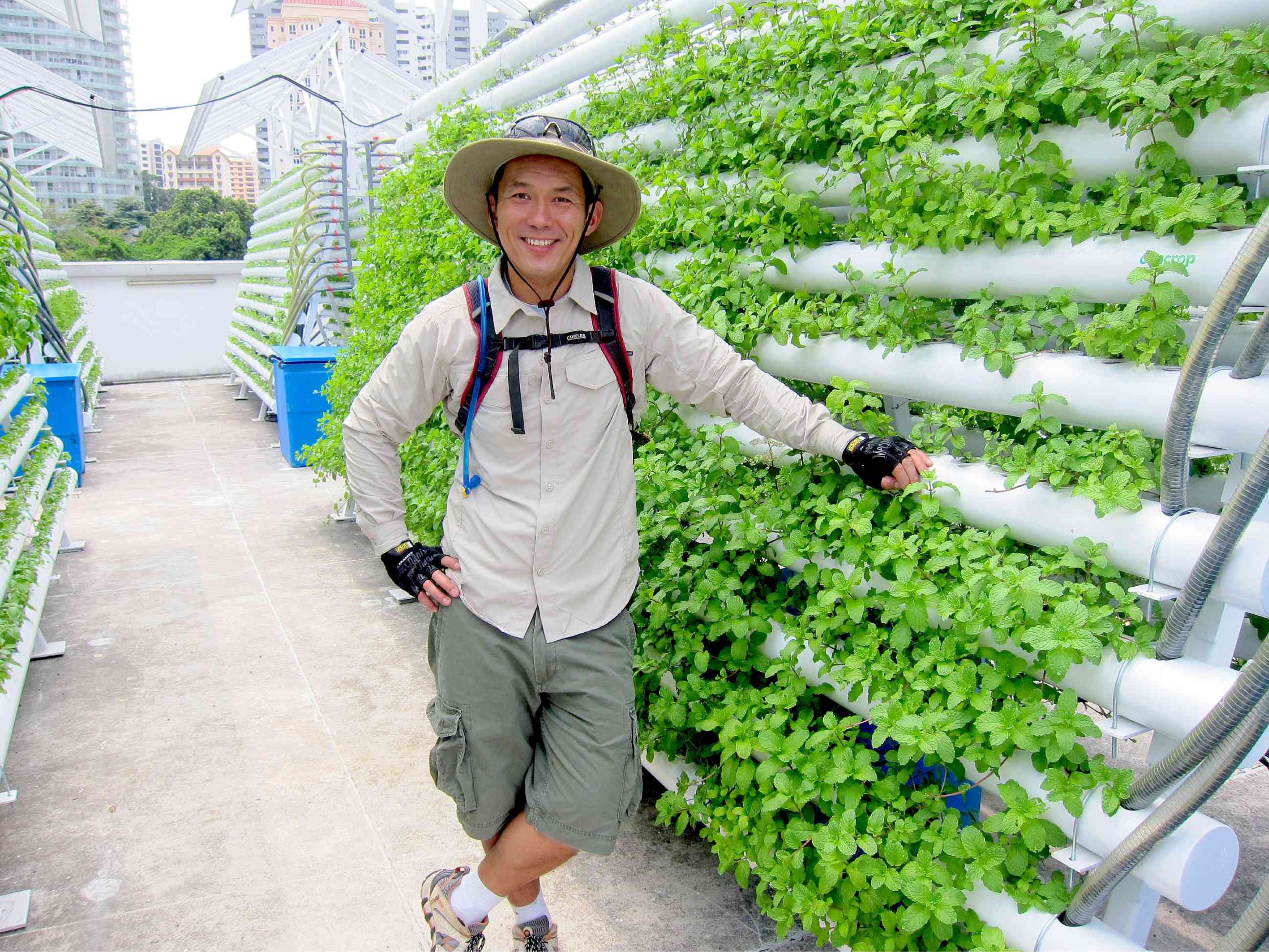
Keith Loh, founder of Comcrop in Singapore, was in fact a restaurateur before he became a rooftop farmer. He noticed how difficult it was for food and beverage establishments to get premium quality produce at cost- effective prices. So he studied aquaponics and merged this with the concept of vertical farming to create his rooftop farm where crops are grown without soil.
“How can you plant without soil?” I asked. I would not believe it myself if I had not seen it with my own eyes. “Isn’t soil the source of a plant’s nutrients so it can grow?” I argued.
Apparently, what plants or crops need are water and air; the soil is just home. Proving that home is where the heart is, aquaponics allows pipes to be the home for plants, making vertical farming possible. A “fish farm” (a tub for tilapia the size of an ice cream fridge) is placed right beside the pipes and has two tubes connected to the pipes where the crops are laid out. One tube sends the plants’ fertilizer in the form of poop from the tilapia, while another tube supplies the plant with water.
It is an incredible system. The giant pipes, laid out in the shape of a giant Toblerone, comprise the farm. The farm I saw was on the rooftop of Scape in Singapore. Beneath the farm was a mall! I suddenly imagined the malls of Manila all having rooftop farms.
“With the use of aquaponics, a close-looped system is created which requires chemical-free farming practice, ensuring that the produce is also natural and clean,” Loh explains.
Today basil, peppermint, spearmint, heirloom tomatoes and leafy greens are harvested from the roof farm.
I tasted the tomatoes. So juicy! And, better believe it, these were picked straight from the farm on the roof!
 —Margaux Salcedo
For your retirement and real estate needs, please visit http://www.gregmelep.com.


Did Christ Ride 2 Donkeys or 1 Donkey on PalmSunday (You may be surprised by the symbolism!)


By Dr. Taylor Marshall
For years I was confused about Palm SundayIn Matthew’s Gospel, we read that Christ rode a female donkey and her baby colt. However, in Mark, Luke, and John, we read that Christ rode a donkey without any mention of the her colt. For some reason, I had imagined that Christ rode the she-donkey and the little colt at the same time – wide straddling both. This seems ridiculous, but I didn’t know how else to visualize what Matthew was describing.
jesus-christ-riding-into-jerusalem-for-passover
I finally found clarity while reading Cornelius a Lapide’s commentary on the passage.According to Lapide, Christ first rode the ass up and down the mount and then rode the colt into the city.
There is a practical reason for this. The she-ass would be stronger and more able to go up and down the terrain. Next, the colt would be able to bring him into the city easily.
Yet there is a mystical signification is this as well. The she-ass and her colt signify “the two sorts of people of which the world is made up—the Jews, accustomed to the yoke of the Mosaic law, who were represented by the ass; and the Gentiles, living up to this time without the Law of God, and who were denoted by the colt.”
The she-ass represents Mother Israel who has been burdened with the Law of Moses. Saint Peter our first Pope described the Mosaic Law as “a yoke…which neither our fathers nor we have been able to bear” (Acts 15:10, D-R).
The young colt represents the new and untrained Gentiles – the wild olive branch that the Apostle describes as the Gentiles.
Christ our Lord rode both to signify that both the Jews and the Gentiles were called to be Christophoroi Christ-bearers.

Now it’s your turn: How did we carry “Christ to the world” in our age. What is the humble donkey or colt in our lives that communicates Christ’s Gospel to others? Please leave a comment.
Get Taylor’s free book Thomas Aquinas in 50 Pages by clicking here.
You can leave a comment by clicking here.

4 Reasons Christ Rode a Donkey

By Dr. Taylor Marshall
Prior to entering Jerusalem, Christ instructed his disciples to acquire for him a donkey (in Matthew’s Gospel a donkey and a colt).
entry
Why did Jesus ride an ass? There are four reasons.
First, the prophet Zechariah wrote: “Behold, your king comes to you, triumphant and victorious. He is humble and riding on an ass, on a colt the foal of an ass.” (Zech 9:9)
The messianic sign was at once perceived by the crowds who hailed Jesus as their king shouting, “Hosanna! Blessed is he who comes in the name of the Lord!” (Mt 21:9) Catholics still shout this Davidic salutation every time the Holy Sacrifice of the Mass is celebrated. It is an acknowledgment that Jesus is the true Davidic Messiah and king.
Secondly, an ass is integral to the story of Abraham’s offering of Isaac, a type of the oblation of the First Born Son as a sign of obedience.
The third reason is that King Solomon rode to his messianic coronation on a mule that had once belonged to David (1 Kgs 1:33-44).
Fourth, King Jehu rode into Samaria (a kind of false Jerusalem) over the garments of his adherents in order to destroy the temple of the false god Baal (2 Kgs 9:11-10:28). One of the first things Christ does upon entering Jerusalem is bring judgment to the Temple which has become a den of thieves. The typology in this account is rather startling as 2 Kgs chapter nine contains strong messianic language. Like King Jehu, Christ the King comes as a judge over ceremonial regulations

For your retirement and other real estate needs, please visit http://www.gregmelep.com.


Sunday, April 13, 2014

The edge of exotic


‘Bhutan’s attraction lies in its well-preserved culture, this being most evident in its many Dzongs—ancient fortresses that serve as administrative and religious centers. Here, commoners, monks, and government officials mingle amid exquisite traditional architecture.’

If I didn’t know any better, I’d say I was in a movie set. I am standing inside a dimly-lit hallway, watching a scene that seems incongruous in this day and age. On a nearby wall, Buddhist prayer wheels spin incessantly to an endless stream of worshippers. Head-shaven monks stand at a doorway, their crimson robes contrasting against the dark wooden panels of this centuries-old temple. The scent of incense hangs heavily in the air, and I watch as devotees bow to a gilded statue of the Buddha. Prayers are offered; mantras are recited. Outside, life unfolds amid a stunning backdrop of terraced ricefields and distant mountains. This setting is exotic in every sense of the word.
Thimphu Dzong
Thimphu Dzong
(Images by Lester V. Ledesma)
The Taktsang Monastery is Bhutan's national symbol
The Taktsang Monastery is Bhutan’s national symbol


I’ve barely spent two hours in Bhutan, and already I am taken in by its unspoiled character. Located on a tiny strip of land between India and China, this kingdom is one of those few, special places that have taken a curious approach to development. We’ve heard about its deeply-rooted Buddhist faith, and the cautious way this long-isolated nation is opening to the outside world. Bhutan’s unique outlook is best summed up in its much-talked about Gross National Happiness Index—a term the country uses to measure its advancement in quality of life.
Elder monks at the Thimphu Dzong
A place this unusual simply begs to be explored—I just had to come down here to take a look. Bhutan’s tourism policy dictates a US$250-per-night tariff—a cost that includes visa, food, lodging, land transport, and guide service. A typical seven-day itinerary adds up to around P125,000. This comes with a minimum accommodation standard of three stars, at spacious traditional-style lodges. Backpacking is simply not an option in Bhutan.  But with annual tourist numbers barely reaching 65,000, even package tourists don’t see much of their kind in these parts.
With such little time to spare, I get on with the tour. My guide, a big Bhutanese guy named Tshering, brought me to the six-centuries-old Changangkha Temple where I got my first taste of the local culture. Afterwards we head off to the main street of the capital Thimphu to get a feel of the city life.
“We call this area ‘Hongkong Street’ because it’s always busy here,” comments Tshering as he points to rows of shops traversing several blocks. Here the similarities end: Instead of skyscrapers and neon signs, Thimphu’s central business district features earthen-walled buildings adorned with traditional wooden frontages. With very few streetlamps and no traffic lights, the neighborhood feels more like a bustling frontier town than a national capital.
Spinning Buddhist prayer wheels
The following days find us all over the countryside. Bhutan’s attraction lies in its well-preserved culture, this being most evident in its many Dzongs—ancient fortresses that serve as administrative and religious centers. Here, commoners, monks, and government officials mingle amid exquisite traditional architecture. There are also the humble little temples that dot the countryside. In the district of Punakha (a three-hour drive from Thimphu), I saunter down ricefields and sleepy villages toward the Chimi Lhakhang, a building dedicated to a beloved saint, the “Divine Madman” Drukpa Kunley, whose sexual exploits defy the notion of abstaining Buddhist holy men.
It is in situations like these where having a guide really proves its worth. Tshering is like a reliable local friend, explaining aspects of his culture that I would otherwise have misunderstood. He is also an excellent translator during conversations with the locals; his input offers valuable insights into a culture I barely know. Indeed, compared to DIY travel with a phrasebook in hand, the presence of a guide opens doors to a richer travel experience.
Rice Farmers in Punakha
Buddhist hermit at the Punakha Dzong
Prayer flags on the mountainside


Interesting as this trip may have been, none of what I’ve seen so far compares to my last destination. A few kilometers north of Paro town stands the Taktsang Palphug. Built on a cliffside some 3,000 feet above the landscape, this ancient monastery is accessible only via a robust, two-hour trek. With Tshering leading the way, I trudge up the steep slope, stopping regularly to catch my breath in this thin mountain air. The knee-busting hike takes us from pine forest to rock face, the trail dotted with numerous shrines and lookout points.
By the time we reach the monastery, I am thoroughly winded, yet elated at reaching Bhutan’s most venerated landmark. Prayer flags flutter with the breeze as I look down at the picturesque valley below. To my side I see a flash of crimson as a pair of monks appears. Behind me I hear the sound of spinning prayer wheels. Once again I smell incense in the air. A place like this doesn’t need a tourist come-on. Bhutan works its magic simply by being itself.
Multi-awarded photojournalist Lester V. Ledesma has covered Asia for over 15 years. He will lead a photography workshop-tour of  Western and Central Bhutan from June 29 to July 5. The seven-day trip boasts evening photography discussions and a full itinerary of genuine cultural experiences. www.facebook.com/phototreks, or email phototreks@skylightimages.info.
For your retirement and other real estate needs, please visit http://www.gregmelep.com.


Friday, April 11, 2014

Planning a successful green house project.


By 


Summer is definitely here.  Many are constantly complaining and longing for the cool weather present during the early part of the year. Summer is also that time of year when many homeowners embark on house construction. They surmise that it is the best time to avoid costly delays in the construction due to heavy rains.
For many, constructing their homes, especially for the first time, is a very exciting undertaking. Unfortunately, many are not aware of what it takes to go through the process. Some people enjoy getting involved with the day-to-day construction activities, but for the vast majority, they are stressed and go through sleepless nights. Some even lose or gain weight.
While it is not possible to totally eliminate the problems associated with house construction, it pays to be very thorough and even meticulous in planning to get the desired result—a successful project that meets the owners’ requirements in terms of quality, time and budget.
The key to it all is planning.  Many of the problems in construction stem from lack of planning.
Wish list
For any project, not just for houses, a wish list  is the starting point, the most important step.  This can be a simple list of the owner’s room requirements to more elaborate catalog of furniture and electronic equipment. The idea is not just to enumerate space requirements but also their functional requirements.
It is also at this early stage that green architecture principles can be seamlessly integrated into the project. How do we bring sunlight in? The use of sliding glass doors, terrace doors, balconies and bigger window openings is now a lifestyle feature.
How do we conserve water?  Do we include a cistern, provide for rainwater collection and graywater plumbing system project from the start?
The wish list, also called the Basis of Design Report, includes requirements for structural, electrical, mechanical and landscaping. It is constantly reviewed and updated by all disciplines especially when revisions are made.
In my experience, what are normally lacking in the owner’s wish list are storage spaces and service areas. If they are included at all, the space allotted is usually not enough.
I designed a house for a client who had it rented to a European couple. It had a courtyard and living-dining areas that open up to a huge garden. These areas did not impress the new tenants; instead they praised the efficient layout of the utility area with laundry equipment, sewing machine and fold-down ironing board properly tucked away in built-in closets.
In developed countries, the service areas are just as important as the major rooms like the living room, dining room and bedrooms, since they do a lot of the house chores themselves.  Some families here are now in the same situation.

Budget
In many cases, owners do not reveal to their architect the true budget they have in mind. Perhaps it is to provide some allowance for cost overruns.
Clients may give a reasonable budget to the architect who will translate this into a defined floor area based on existing cost parameters. With the wish list and budget in hand, the architect’s task is to verify if they are compatible. Adjustments can be studied if the requirements for space are too much for the budget.
For example, careful planning can be done so that the basic core of the house can be built first and the other areas to be built later. Another way is to focus on the shell with limited finishes in most areas. The most obvious solution is of course to reduce the floor area, and this is normally the last alternative.
There are also ways to incorporate green features  in the future, if they cannot be included in the budget. Electrical conduit pipes without wiring can be provided at present for future solar panel connection. Water pipes can be done in anticipation of future installation of more expensive cistern and pumps. The same goes for the graywater system.  Graywater system conserves water by recycling it from kitchen sinks, wash basins and showers to be used for flushing toilets and irrigation purposes.

Architect
The architect is the best person to translate the wish list into a workable plan to suit the owner’s requirements while staying within the budget. It will be very helpful if the architect is familiar with the multidisciplinary aspects of green design so that the wish list can be accurately interpreted into drawings and details to be implemented at the project site.
Building Green: An LGU imperative. For this reason, the Green Building Initiative, in collaboration with the Climate Change Commission under the Office of the President, and the International Finance Corp., will hold a forum on April 23  at the Dusit Thani Hotel in Makati for the greening of the building officials of all local government units.
For comments or inquiries, e-mail amadodejesus@gmail.com
For your retirement and real estate needs, please visit http://www.gregmelep.com.