Sunday, March 30, 2014

Check out Davao this summer–starting with its ‘cabrito’ and goat cheese


By 


 20 88 47

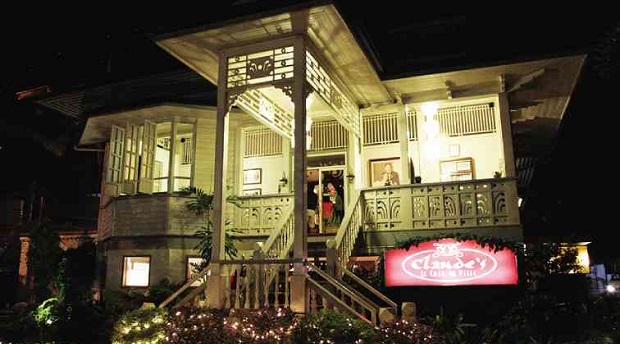
CLAUDE’S now occupies the Oboza Heritage House
The oven-roasted baby goat that greeted us at the Malagos Farmhouse outpost in Davao City was a treat we weren’t expecting but one we all welcomed. After all, the brand is known mainly for its range of exceptional goat cheeses.
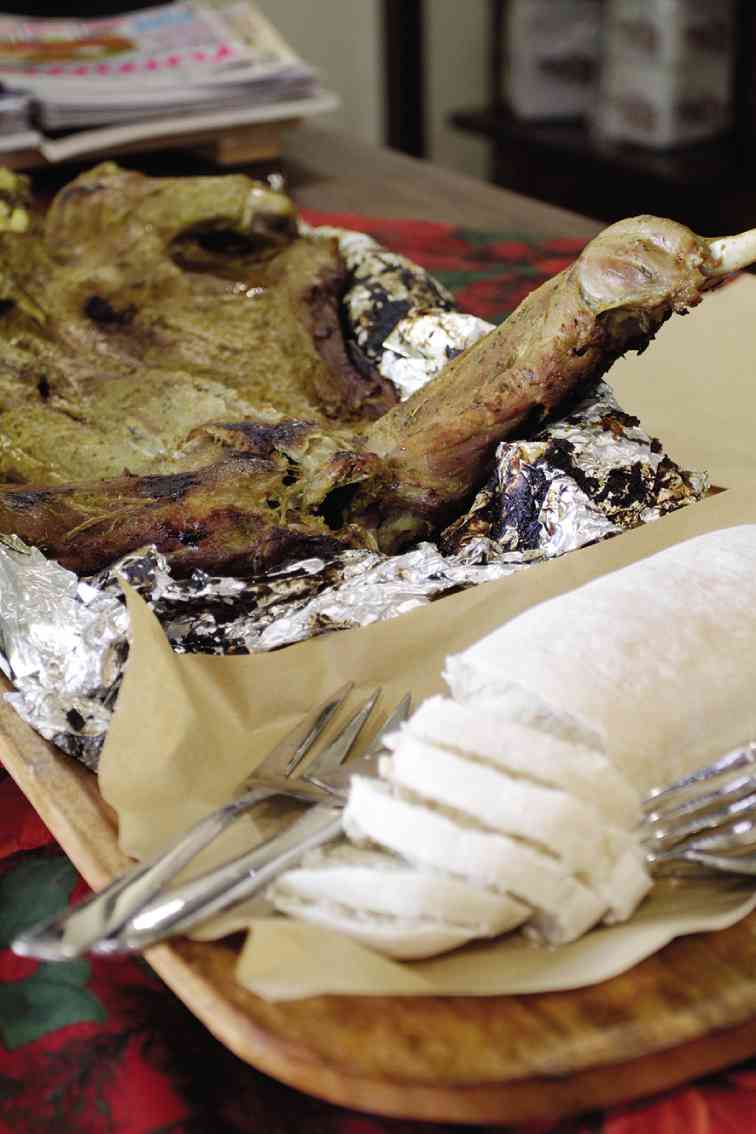
“CABRITO” (roasted young goat) and freshly baked bread at Malagos Farmhouse
The “cabrito” (roasted young goat) was a surprise the owners had whipped up for the lifestyle press that had flown to Davao upon the invitation of Park Inn by Radisson.
The year-old, 204-room hotel located behind SM Lanang was designed to cater to business and leisure travelers. It would be our home for the next few days.
Big sale
We realized soon enough that Davao —like Bacolod and Ilocos—is a place where you can eat well provided you or your hosts know where to go.  It also wants to be a shopping destination with its ongoing Big Davao Fun Sale that runs until April 16.
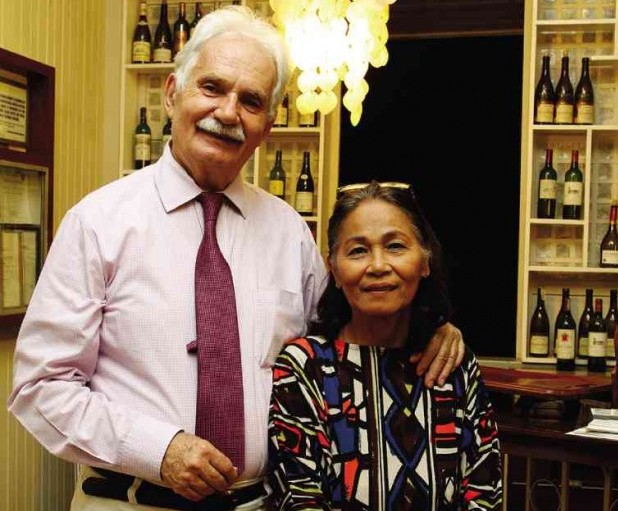
CHEF-PATRON of Claude’s, Claude Le Neindre, with Tess Le Neindre
Many of the city’s malls and stores are joining the project. Weekly themes include Health and Beauty (March 16-23), Electronics and Gadgets (March 24-30), Home and Travel (March 31-April 6) and Active Lifestyle/Fashion (April 7-16). Dining, crafts, fruits and flowers are on sale on the month-long event.
“This is the first time we are holding a four-week shopping event. Our primary goal is to establish Davao City as a unique, fun and preferred shopping and dining destination in the country,” said Art Boncato, assistant secretary at the Department of Tourism.
Our first day started with lunch at RBG, the all-day dining outlet at Park Inn by Radisson where the chef prepared several dishes of local produce. One dish that stood out was a clam pasta that was rich and flavorful.

ENTERPRISING cheese maker Olive Puentespina
We then headed to Malagos Farmhouse and experienced the warmth and hospitality of the Puentespinas, Olive and Roberto Jr. Until recently, guests could sample the cheeses only in an open area, but Olive decided to put up a tasting room, Leon’s Lounge, named after her small child who passed away.
The lounge was the perfect place to enjoy the cabrito with a few cheeses, some bread and several bottles of chilled wine.
Olive, who oversees the goat raising and is a self-taught cheese maker, said, “If you are a young male goat in my herd, you have little use for me.” For quite some time now, she has been pushing cabrito as an option to “cochinillo” (roast suckling pig). She has even begun selling goat pelts that decorators use as accent pieces.
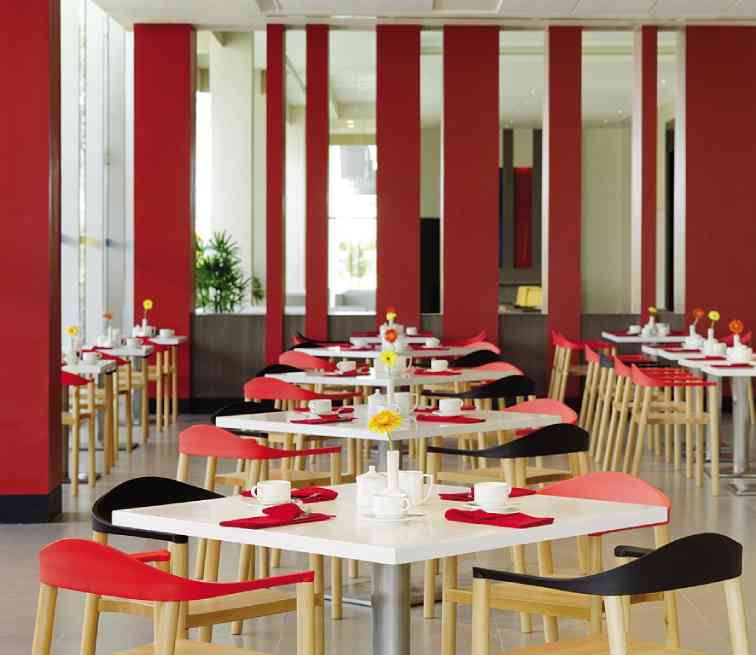
BRIGHTLY colored RBG interiors
For all our protests, we ended up devouring the hapless goat. There was none of the gaminess one expected. The meat was soft, tender and perfectly flavored.
Olive sells the slaughtered goats whole and provides instructions on how to cook them, usually over coals or butterflied in an oven.
If cabrito holds no allure for you, there are always Olive’s cheeses. Her feta is unlike the salty Greek version but is perfect diced and tossed in fresh garden salad. The soft goat cheese flavored with ripe mango is also a favorite.
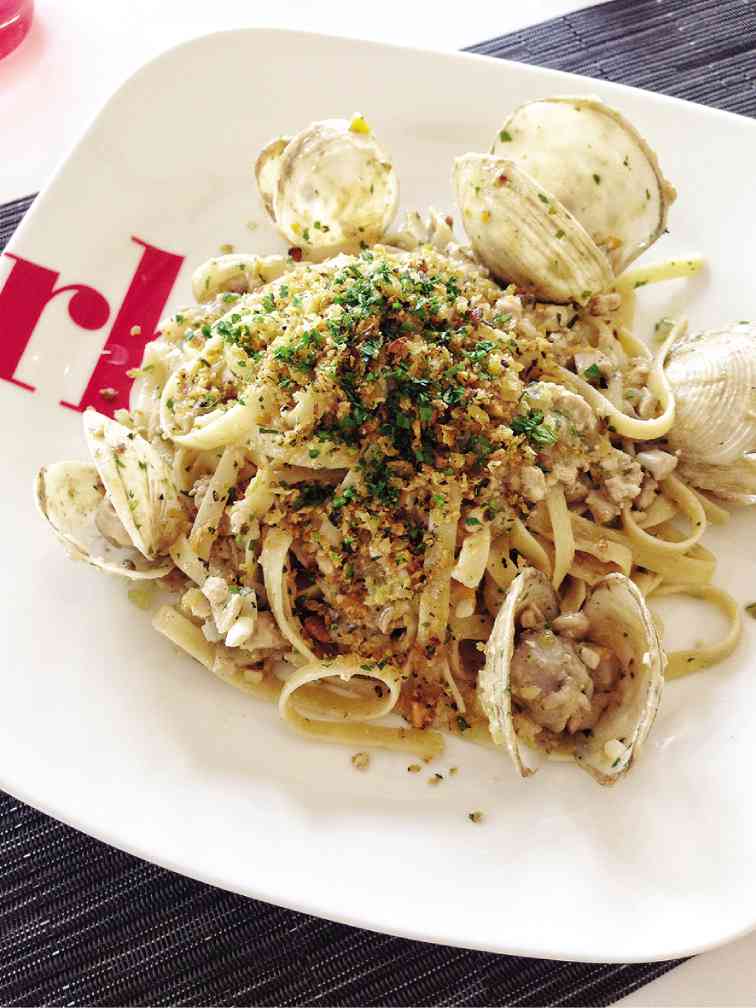
PASTA de Davao at RBG, Park Inn by Radisson
New life to old houses
During our short stay in Davao, we were able to dine in two restaurants that were worth visiting: the almost 20-year-old Claude’s Cafe de Ville, and the newly opened The White House Fusion Cuisine and Wine Lounge.
Both are housed in what used to be two of the city’s grand old mansions.
At Claude’s, we met the husband-and-wife team of Claude and Tess Le Neindre who regaled us with stories of how they met and, later, why they decided to put up a restaurant.
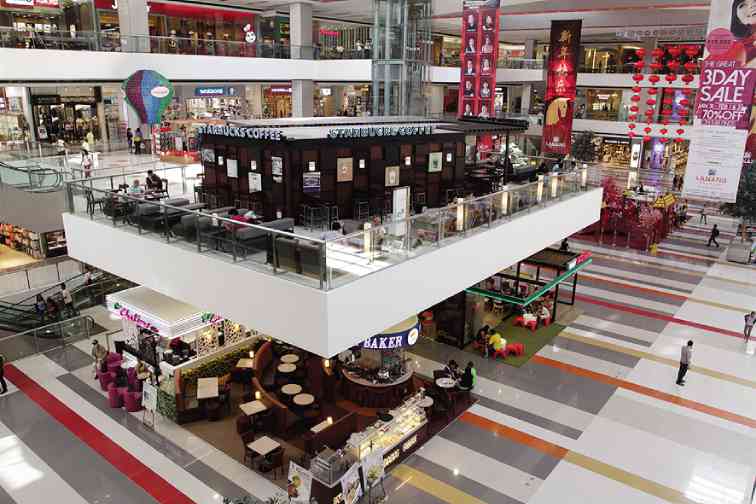
SM LANANG has a floating Starbucks over a branch of French Baker
We had an eight-course dinner but the one that really wowed was the first consisting of fresh oysters from Canada. Cold, plump and briny—delicious even without any of the sauces.
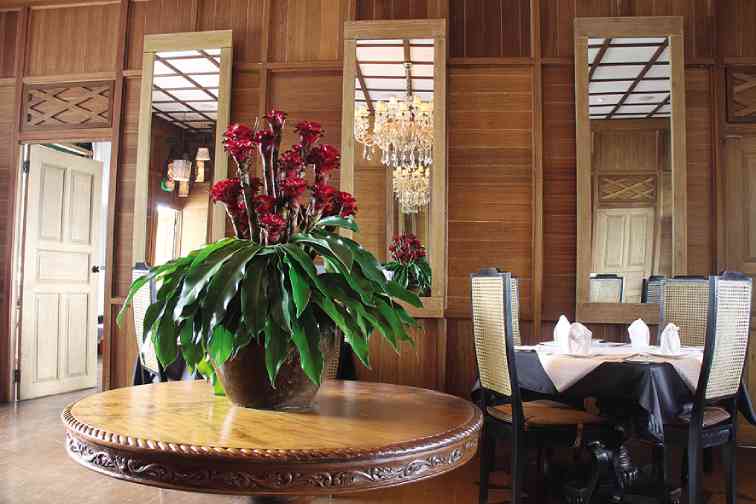
ONE OF several dining areas at The White House
On our last night, we dined on oyster shooters, soup with enoki mushrooms and braised pork belly at The White House. Dessert of caramelized bananas and ice cream was served at the restaurant’s azotea on a table lined with glowing lamps, under a sky studded with stars.

Park Inn by Radisson Davao: JP Laurel
Avenue, Lanang, 8000 Davao City.

Malagos Farmhouse: Bolcan Street,
Agdao, 8000 Davao City.
Claude’s Cafe de Ville: Oboza Heritage House, 143 Rizal Street, 8000 Davao City.
The White House Fusion Cuisine and Wine Lounge: Camella Northpoint, Bajada, 8000 Davao City.


For your retirement and other housing needs, please visit http://www.gregmelep.com.

Saturday, March 29, 2014

Condo or house and lot? 8 factors to help you decide


By 

 0 228 222

Do you find yourself in a predicament whether to buy a house and lot or a condominium unit? Choosing a location, and determining the budget, will help you make a swift purchasing decision, but these don not comprise all factors.
Inquirer Property asked property analysts the advantages of condominiums over house and lots, and vice versa.

Here are eight factors your buying decision would most likely depend on:

1. Cost. If both a condominium and a house and lot are located in the same prime area, the former is almost always cheaper, according to property analyst Enrique M. Soriano III. He added that reputable developers may even price condo units below P1 million in prime locations.

Compare this to the price range of an entry-level, single-attached house and lot within Metro Manila but outside the central business districts: P1.5 million to P3 million, while mid- and high-priced houses range from P6 million to P25 million.

CB Richard Ellis Philippines’ data, on the other hand, showed that the price of a house and lot in the primary market in Metro Manila could go as high as from P22 million to P28 million.

Soriano, who is the Ateneo program director for real estate and senior adviser for Wong+Bernstein Business, said: “Developers’ relentless research and development and value reengineering have significantly lowered construction costs that condominium price points are now comparable to the price of a low-cost house and lot.”

CBRE said that, although condominiums are recognized for their luxurious living themes, these are known to be more affordable than houses sold in most cities, such as Manila. And unlike townhouses, condos are much more affordable.

2. Location. In Metro Manila, the trend for prime locations has favored condominium sales, as these are the most reasonably priced residential units in the market.

CBRE Philippines said condominium projects are the most viable developments, given the limited amount of developable space in Metro Manila and other congested cities. In cities, at least, condominium living is more practical for individuals or families.

3. Convenience and amenities. For high-level executives who need to be located inside the business districts, living in a condominium puts them closer to the workplace, giving them the advantage of less travel time and transportation expenses.

Soriano observed that most condominiums offer amenities like pools, playgrounds, function rooms and gyms that may be too expensive to put up in one’s own house.

He added that condo units also have 24-hour security and on-call maintenance, on top of building maintenance handled by the associations.

“Condos can also be used to earn passive income if you plan to sell or have it rented out once it’s ready.” he said.

4. Freedom of space. On the other hand, a house and lot purchase, Soriano noted, offers more freedom in terms of area; you don’t share ownership of the property; there is no common ownership of the land (The life of a condo is only good for 50 years); once fully paid for, it is considered yours, and that no one can evict you from your place.

“A house and lot is a long-term investment that you can pass on to your children and grandchildren. Unlike condominiums, house and lots are generally more spacious,” shared Soriano.

5. Improving highways, transport systems. Here’s another advantage going for house and lot buyers. “There’s rapid urbanization outside Metro Manila, and with the development of improved roads and highways, the provinces are now more accessible,” Soriano said.

6. High rise versus low rise. Unlike in horizontal developments (such as subdivisions) where the risk of flooding can be higher, condos, due to their vertical nature, are rarely affected by floods.

7. Overseas Pinoys’ exposure to high-rise living. Long-term overseas workers in areas like Singapore, Hong Kong and Middle East have grown more accustomed to condo living.

For your retirement and other housing needs, please visit http://www.gregmelep.com.

Developer launches P700M office tower


-AA+A

INSTEAD of going residential for its first vertical project, homegrown developer King Properties decided to jumpstart its first high-rise project with an office tower in the center of Cebu City’s major business hubs.
The P700-million tower, Avenir, will house a mix of office spaces, which include office suites, executive offices and home office suites. It is situated in a 25,000-square-meter property at the heart of Barangays Lahug, Mabolo, and Banilad.
Richard King, King Properties executive director, said the decision of the company was prompted by the high demand for offices in Cebu, especially now that there is a growing number of business process outsourcing (BPO) companies, entrepreneurs and independent professionals.
“Cebu is an entrepreneurial hub…There really is a high demand for such kind of projects in Cebu. There’s a lot of lawyers, accountants, freelancers and consultants who need offices,” King told reporters.
The project highlights its home office suites, which offer the flexibility of having a home unit and an office unit. Floor area ranges from 25 to 60 square meters. To optimize the owner’s working and living space, units come out in an optional fit-out package.
Lorraine Tan, King Properties sales and marketing consultant, said the company is one of the first in Cebu to offer home office suites. A home office suite, she said, comes with a kitchen, toilet and bathroom.
Of the 256 offices in Avenir, 183 will be home offices, 66 will be executive offices and seven will be premier offices.
Avenir’s premier offices, which will offer bigger spaces, are ideal for BPOs, said Tan.
Avenir will also be equipped with a fiber-optic backbone to serve the
telecommunication needs of BPOs and other businesses. The developer has also promised to provide 100 percent back-up power generation.
Avenir is a Philippine Economic Zone Authority-accredited site, which means locators can avail themselves of the government’s fiscal and non-fiscal incentives.
To address service needs of businesses, it also has put up a business club, Avant, which will provide subscription-based business solution services like call and mail handling, print and copy services, contract management, and lead generation, among others.
It will also offer shared facilities like a business lounge, virtual workstations and conference rooms.
Aside from end-users purchasing an office suite in Avenir, Tan has called on potential buyers to invest in office units in the same way they consider buying a condominium unit as a form of investment.
She said investors can rent their office units to others for a minimum contract of three years. “This is a good investment because rental increases by year,” she said.
She expects there will be a 20 percent appreciation of unit prices after the turnover, which is scheduled in the third quarter of 2016.
King Properties Corp. is also the developer of Modena subdivisions in Mactan and Minglanilla. It has already constructed 400 houses and will add 150 houses in the town of Consolacion, with the project launch targeted this year.
King said for their vertical projects, the company will concentrate on office towers. Vertical residential towers are still not in the pipeline.

Boat Ride in the Lake

By 


 0 35 32


BOAT RIDE ON THE LAKE A woman in t’nalak costume serves as a tour guide of visitors on a boat cruising near one of the “seven falls” in Barangay Lahit, Lake Sebu, South Cotabato province. COCOY SEXCION/CONTRIBUTOR
The Inquirer is running a series of articles on the country’s tourism crown jewels— somehow uncut but equally sparkling and surprising as the usual vacation haunts. The stories will appear three times a week during the summer months. Please send us your own hot go-to discoveries to summer by. Text 09178177686 for details.–Ed.

LAKE SEBU, South Cotabato—Perched above the hills, some over 300 meters  above sea level, this first-class municipality in Mindanao’s south-central tip is a veritable paradise for tourists of all persuasions.
A visit to Lake Sebu is an encounter with nature, culture and adventure, all in one package. Its people, numbering more than 75,000, boasts of some of the country’s most picturesque lakes and a rich T’boli culture. And an unforgettable heart-pounding trek to the mountains.

One need not empty bank accounts or break piggy banks to be able to afford the trip. For as low as P3,900, tour packages—including transportation, food and accommodations—are being offered by Destination Mindanaw, a fledgling tour operator in the region that caters to local and foreign tourists who want to experience the thrills and frills of Lake Sebu.

Not passing up the chance, together with 16 others, we set out from Tagum City in Davao del Norte province, bracing for the sights and experiences of a destination seven hours away on a 20-seat air-conditioned bus of Davao Metro Shuttle. The bus company is owned by the Tagum-based Uy family, which runs Destination Mindanaw.
The trip went smoothly and without much delay, except for two stopovers for toilet breaks at a gas station along the national road in Davao City and at a mall in General Santos City, 132 kilometers apart.

No empty stomach

Destination Mindanaw provides a light breakfast of rice, corned beef, eggs and a Cavendish banana, so leaving home on an empty stomach to catch the 5 a.m. trip wasn’t too much of a sacrifice. On the bus, one of the guides, Nino Coquilla, dishes out trivia and other information tidbits to passengers about a particular town or place along the way.
The bus pulled over for lunch at The Farm, a 12-hectare mountain resort on Carpenter Hill, Koronadal City, South Cotabato province, six hours or so from Tagum and about an hour away from Lake Sebu. The Aviary, The Farm’s restaurant, serves French and Filipino cuisine cooked up by Manila-based chef Humphrey Navarro.
“Guests can indulge in gastronomical delights similar to that offered in five-star hotels, but at affordable prices,” says Marlon Navarro, The Farm resort manager.

After lunch, the bus is on its way, negotiating a well-paved road connecting South Cotabato and Sultan Kudarat provinces. Lush forests hugging mountains and the majestic Mt. Matutum to the east are irresistible attractions.
In the municipality of Surallah, tourists are treated to a visual feast consisting of tribal artworks by known Mindanao sculptor Kublai Millan. His creations of life-size statues of T’boli men and women and their indigenous instruments dominate the main road arteries and plaza.

A swing to the left of the Surallah-Tacurong highway brings us to our main destination. Along the 21 km of paved road is an expanse of pure rustic beauty—vast pineapple fields stretching to the edge of glistening, sun-kissed hills as the mighty Allah River, the source of life to the “rice granary of the South,” cuts through the fertile valley.

Like Baguio

A slow climb on good roads to Lake Sebu offers a commanding vista of pines and the balmy whiff of an afternoon breeze, reminiscent of the uphill ascent to that fabled highland resort city in northern Luzon: Baguio. Lake Sebu, in fact, is known as the summer capital of south-central Mindanao.

Passengers are treated to a picture of nature in contrast—on the left, unfolds a panorama of hills and forests; on the right, the three “great lakes” welcome the first-time visitor.

Lake Lahit, the smallest with an area of 34 hectares, is surrounded by hills dotted with huts and a handful of houses made of concrete. Lake S’loton (Seloton), the deepest at more than 200 feet (60 meters), is wide enough (38 ha) to host hundreds of cages of tilapia, a major source of livelihood of residents.

The last of the upland lakes is the eponymous Lake Sebu, the largest at 380 ha. It has 12 islands and islets nestling communities of indigenous T’boli and on its shores, dozens of resorts.
Boat cruise
Punta Isla is a must-visit resort. For a minimal price, tourists are treated to a fantastic view up close of six of the islands and islets in a 30-minute boat cruise around the lake. Not to mention the opportunity to witness a way of life like no other, of T’boli islanders as they go about their daily chores on board an owong, a dugout canoe, the main mode of interisland transport.

A T’boli tour guide accompanied the visitors throughout the itinerary, complementing the visual attractions with information on everything and anything about the lake and T’boli culture in general. One guide, Sherilyn Gandam, led a group of young people who performed indigenous dances, songs and musical instruments during nightly cultural shows at the resort.

For foodies, the cuisine is exquisite and sumptuous. One can choose from a wide array of tilapia-based dishes for as low as P190.

Souvenirs ranging from commemorative shirts to tribal trinkets are offered at bargain prices (as low as P5 a piece) are available at the resorts or roadside booths, sold by the very women whose hands made the intricate designs.

Weaver of dreams

Rounding up the cultural tour of Lake Sebu is a visit to Lang Dulay and her women weavers of dreams. The 89-year-old Dulay was given the National Artist for Culture award in 1997 for her world-renowned “t’nalak” loom weaving, a T’boli way of weaving abaca hemp into complicated cloth designs using tree dyes.

Dulay and her school of dream weavers are just a kilometer away from Punta Isla, in Poblacion, Lake Sebu.
Before calling it a night at any of the town’s inns or Punta Isla’s cozy accommodations, tourists can watch cultural presentations and be enthralled by T’boli dances and music. Breakfasts, on the other hand, are usually punctuated with photo shoots of lakeside communal life.

Capping the two-day sojourn is an exhilarating adventure to Hikong Mountain Resort, a high-altitude, adrenaline-booster jaunt not for the faint of heart.

The upland resort in Purok Malipayon, Lahit village, boasts of the awesome Seven Falls Zip Line which, at 740 meters (2,428 feet) long and 183 meters (600 feet) above sea level, is reputed to be one of the country’s longest and highest recreational cable lines.

The bumpy drive along the ascending road is as daunting as the zip line ride itself. For perennial traveler Jovelyn Tundag, the heartstopping view of cliffs that hug one side of the road can spook even zip line addicts like her. “The road is frighteningly steep,” Tundag says.

Zip excitement

A 74-step concrete walkway leads down to a bridge where tourists can snap photos of the majestic Falls 2, over a hundred meters high of cascading waters. Or they can walk dozens of steps closer to the waterfall, unmindful of the sprays of water drenching their clothes.

For P300, brave hearts are strapped to the zip line and set off to zoom across two hills.
Moving at a speed of 51 km per hour, the daring are able to get a bird’s eye view of the vast hills, “fly” over and catch a breathtaking view of five of the seven falls. For 48 seconds, one can imagine how the ground looks like from above or even shudder at the thought of a free fall.

The return trip involves a 400-m long, 600-foot high line, which leads to a shed-like structure, or terminal. Passengers can have their photos taken during the entire trip and taken home as mementos at the end post.

Visiting celebrities

Alex Calixtron, one of the zip line workers, says tourists have nothing to worry about as the facility, built in 2009, undergoes a monthly inspection.

Managed by the provincial government, the Seven Falls Zip Line occupies a vast area of hills owned by indigenous peoples and settlers, who lease the property to the provincial government.

“Aside from providing employment to residents, the zip line is also helping promote our town to the rest of the country,” Calixtron says.

“Celebrities such as actors Kim Chiu, Gerald Anderson and beauty queen Shamcey Supsup have already visited us,” he says.

The trip back home is just as exciting. Tourists can dine at restaurants dotting Koronadal, like Mang Gorio’s Bahay Kainan, or drop by for dessert at Saravia village.

For more pasalubong, one can stop at one of the numerous stalls lining the national road for fresh pineapple and other fruits.

So what are you waiting for?  Grab that favorite backpack and head to Lake Sebu. You won’t be sorry you did.


For your retirement and other housing needs, please visit http://www.gregmelep.com.

20 Uses For Coke Other Thank Consumption. Proof that it Has No Place in Your Body!


I absolutely LOVE Coke, but this just made me re-think my love for the beverage.

Coke-Proof


Coca Cola is the most recognized trademark in the world, and  it is the world’s second-most famous word after “Hi.” However, the drink itself is a real poison to the human metabolism. The level of acidity of coke is almost the same  as the acidity level of battery acid. In addition to that Coke can clean dirty surfaces almost the same to and often much more better than the most used toxic household cleaners.
Clean water is more expensive than a bottle of Coca Cola in many countries. Coke has done a lot of efforts in advertising to get people consumer blindly this beverage that is very destructive for our body.
Those who  consume sodas such as Coca Cola have a 48% increase in heart attack and stroke risk, compared to people who do not drink the sodas at all or did not drink them every day. A study published in the journal Respirology reveals that soft drink consumption is also associated with lung and breathing disorders including asthma and chronic obstructive pulmonary disease (COPD).
The carbonation in Coke causes calcium loss in the bones through a 3-stage process:
  1. The carbonation irritates the stomach.
  2. The stomach “cures” the irritation the only way it knows how. It adds the only antacid at its disposal: calcium. It gets this from the blood.
  3. The blood, now low on calcium, replenishes its supply from the bones. If it did not do this, muscular and brain function would be severely impaired.
But, the story doesn’t end there. Another problem with most Coke is it also contain phosphoric acid (not the same as the carbonation, which is carbon dioxide mixed with the water). Phosphoric acid also causes a draw-down on the body’s store of calcium.
So Coke softens your bones (actually, makes them weak and brittle) in 3 ways:
  1. Carbonation reduces the calcium in the bones.
  2. Phosphoric acid reduces the calcium in the bones.
  3. The beverage replaces a calcium-containing alternative, such as milk or water. Milk and water are not excellent calcium sources, but they are sources.
Esophageal cancer was very rare two generations ago — now, it’s common. The basic mechanism works as follows:
  1. Mechanical damage to cells is a huge risk factor for cancer. It’s why asbestos particles, for example, cause lung cancer.
  2. All soft drinks cause acid reflux (stomach acid rising up past the esophageal valve). This is more pronounced when the body is horizontal (as in sleeping), but the sheer volume of Coke and soft drinks consumed in the USA means the acid reflux is well past the danger point. Any time you ingest a gassy drink, you are going to get belching–and acid into the esophagus. How much is too much? The research doesn’t say where the limit is–it only shows that most of us are far, far, far past it.
  3. stomach acid dissolves tissue — that’s its purpose. The stomach lining does not extend into the esophagus, so the lower esophagus gets damaged by acid far more frequently in soft drink users than in non soft drink users. This results in a radical increase in cell mutations, along with a far higher level of free radicals.

20 PRACTICAL USES FOR COKE

Coke acts as an acidic cleaner. The amount of acid in soda is enough to wear away at the enamel of your teeth, making them more susceptible to decay. In tests done on the acidity levels of soda, certain ones were found to have PH levels as low as 2.5. To put that into perspective, consider that battery acid has a pH of 1 and pure water has a pH of 7.
To prove Coke does not belong in the human body, here are 20 practical ways you can use Coke as a domestic cleaner:
  1. Removes grease stains from clothing and fabric
  2. Removes rust; methods include using fabric dipped in Coke, a sponge or even aluminum foil. Also loosens rusty bolts
  3. Removes blood stains from clothing and fabric.
  4. Cleans oil stains from a garage floor; let the stain soak, hose off.
  5. Kills slugs and snails; the acids kills them.
  6. Cleans burnt pans; let the pan soak in the Coke, then rinse.
  7. Descales a kettle (same method as with burnt pans)
  8. Cleans car battery terminals by pouring a small amount of Coke over each one.
  9. Cleans your engine; Coke distributors have been using this technique for decades.
  10. Makes pennies shine; soaking old pennies in Coke will remove the tarnish.
  11. Cleans tile grout; pour onto kitchen floor, leave for a few minutes, wipe up.
  12. Dissolves a tooth; Use a sealed container…takes a while but it does work.
  13. Removes gum from hair; dip into a small bowl of Coke, leave a few minutes. Gum will wipe off.
  14. Removes stains from vitreous china.
  15. Got a dirty pool? Adding two 2-liter bottles of Coke clears up rust.
  16. You can remove (or fade) dye from hair by pouring diet Coke over it.
  17. Remove marker stains from carpet. Applying Coke, scrubbing and then clean with soapy water will remove marker stains.
  18. Cleans a toilet; pour around bowl, leave for a while, flush clean.
  19. Coke and aluminum foil will bring Chrome to a high shine.
  20. Strips paint off metal furniture. Soak a towel in Coke and lay it on the paint surface.
Now can you imagine what is does to your stomach lining? 
Who needs the ‘household and cleaning’ section at the hardware store when we have Coke.
[Source: “20 Establish Uses For Coca Cola Proves It Does Not Belong In The Human Body”, from preventdisease.com by John Summerly]
If you will share this then probably few more people will be alert of this Danger.
For your retirement and other housing needs, please visit http://www.gregmelep.com.