Showing posts with label camarines norte. Show all posts

Sunday, May 25, 2014

Fear of becoming Boracay descends on Calaguas.


By 

 23 72 22

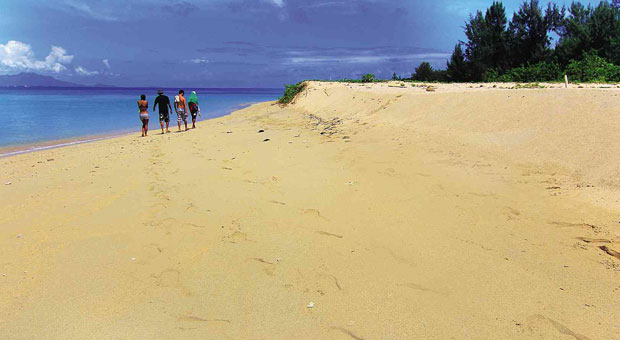
A stretch of white-sand beach in Calaguas becomes a magnet for tourists which brings challenges to residents and officials governing the group of islands, among them how to keep the place from turning into another Boracay. SHIENA BARRAMEDA/INQUIRER SOUTHERN LUZON
CALAGUAS, Camarines Norte— As tourist arrivals skyrocketed from an estimated 10,000 per year to more than 15,000 since it topped an online poll for tourism gems in the Philippines, the Calaguas group of islands in Camarines Norte is now in danger of turning into another Boracay—pretty but packed.

Due to a common fear among residents and officials of their island suffering the same fate as Boracay did, private-sector groups and the local Coast Guard of Camarines Norte are taking the initiative of keeping the islands’ pristine white sands as “virgin” as possible.

That they exert extra effort is an understatement. They go beyond their groups’ budget and dip into their own pockets.
Noli Pajarin, tourism officer and accountant of the municipal government of Vinzons that has jurisdiction over Calaguas, said waste management, boat traffic and docking are some of the major problems that officials face.

He said the sudden surge in the number of visitors made these problems more glaring on the group of islands, which has no concrete structure or modern facility simply because officials and residents don’t want these.
A private resort operates there—Waling-Waling.

Threat to swimming

Boats that bring tourists to Calaguas became a threat to swimmers during the Holy Week when the entire shore of Mahabang Buhangin, Calaguas’ primary tourism site, was occupied by the vessels, Pajarin said.
The effects of tourism are felt by this boy, who shows off a small boat he and his friends made out of materials found where they live. They sell the small boats for P400 each to tourists. SHIENA BARRAMEDA/INQUIRER SOUTHERN LUZON
The Calaguas group of islands is found off the northern shores of the Camarines Norte towns of Paracale and Vinzons.

It has two major islands—Tinaga and Guintinua—and 11 minor islands—Maculabo, Cagbalisay, Bendita, Comalasag, Siapa, Huag, Cagbalisay, Balagbag, Pinacuapan, Samur and Pinagcastillohan.

Mahabang Buhangin beach is on Tinaga Island, which is also known as Calaguas Island for easy reference and for tourism purposes.

Tinaga is about 2 hours by boat from the port of Vinzons.
The islands are under the jurisdiction of the town of Vinzons, except for Maculabo, which is under the  municipality of Paracale.

With the help of local groups, like Vinzons’ Jaycees, Pajarin was able to gather manpower and resources for coastal cleanup and information drives for residents on Tinaga and Guintinua islands.

He said the information drives were good tools in convincing residents of Tinaga’s villages to become conscious about the effects of more tourists on the environment.

As information drives awareness, the residents became vigilant partners in keeping the coastal area of Mahabang Buhangin clean, especially during the off season (October to January) when waves from the Pacific Ocean are too dangerous for small boats.

Lt. Senior Grade Glenn Mago, the Coast Guard chief of Camarines Norte, said the Coast Guard has been trying to keep boats off the beach of Mahabang Buhangin by asking boatmen to dock their vessels a few meters from the shore.

Toilets

Mago said there is also a need to build toilets far from the shore to prevent contamination in the waters, as what happened in Boracay at the height of an E. coli contamination there.

The Coast Guard, he said, is also coordinating with the local government of Vinzons for a clearer waste management plan that would prevent tourists from leaving trash behind.

As of now, officials can’t do anything much except remind tour operators of their responsibility to keep their guests from turning the beach into a garbage bin, said tourism officer Pajarin.

He said boatmen are under instruction not to dispose of waste water into the sea as this may contain gasoline.
The provincial government is set to draft a comprehensive tourism ordinance on which all local government units in the province will base their tourism plans, according to Camarines Norte Gov. Edgardo Tallado.

He said the ordinance would list down the do’s and don’ts for tourism stakeholders in the province.
He added that a causeway is also set to be constructed in Barangay (village) Mangcawayan on the opposite side of Tinaga Island where boats could dock after dropping off their guests on Mahabang Buhangin to avoid congestion on the shore.

For your retirement and other real estate needs, please visit http://www.gregmelep.com.

Friday, April 4, 2014

Magic of Mercedes’ 7-island paradise


By 


BEACH EXCURSION Children enjoy the fine sand and calm waters on Canimog Island, one of the seven wonders of the Mercedes Group of Islands in Camarines Norte province. The island is adored by backpackers, campers and tourists who are looking for a more daring travel adventure. MARK ALVIC ESPLANA/INQUIRER SOUTHERN LUZON
The Inquirer is running a series of articles on the country’s tourism crown jewels—somehow uncut but equally sparkling and surprising as the usual vacation haunts. The stories will appear three times a week during the summer months. Please send us your own hot go-to discoveries to summer by. Text 09178177586 for details.–Ed.

NAGA CITY, Philippines—Magical may not be the right word to describe the seven wonders surrounded by white sand scattered just off the coast of Mercedes town in Camarines Norte, but it sure comes close to it.

Located at the east of Camarines Norte, the Mercedes Group of Islands is a wonderland of white sand with a surprising abundance of pine trees and protected fish and coral sanctuaries, just a one-hour boat ride away from the mainland.
It is now being touted by locals and its municipal government as the next big attraction in Northern Bicol, Coleen Ibasco, Mercedes Tourism Officer, said.

The islands of Caringo, Canimog, Apuao Grande, Apuao Pequeña, Canton, Quinapaguian and Malasugui are offered as an adventure package that would include excursions to its white-sand beaches, mountain hiking and trekking, boating and kayaking and snorkeling, she added.

Although it has not yet attracted enough publicity, Mercedes’ seven-island paradise is a favorite of backpackers, campers and tourists who seek to experience a different travel adventure apart from beachcombing and indulging in extreme sports like kite-surfing that Camarines Norte has in store in Bagasbas Beach and Calaguas Island.
Ibasco said the Mercedes Tourism Office is working with other local government units (LGUs) in the Bicol region to promote the potentials of the Mercedes Group of Islands.

In Naga City, Alec Francis Santos, head of the Naga Arts Culture and Tourism Office, said united LGUs under Naga Excursions (Naga X) are planning on creating a tour package that would involve a trip to the Mercedes islands.

Big 4

The main attractions of the Mercedes tour are the four largest islands of Caringo, Canimog, Apuao Grande and Apuao Pequeña, Ibasco said.

Only two of the islands, Caringo and Apuao Grande, are inhabited by residents.

Despite the rising influx of visitors, the LGUs and residents themselves were able to preserve the islands’ diverse ecosystem, lush mini forests and pine tree groves, Ibasco said.
If you take the route from Mercedes Port, your tour will start with Canimog Island. The route via Palms Farm Resort in Cayucyucan starts at Caringo.

Canimog, the largest among the seven islands, is shaped like a crocodile, thus, the nickname “Crocodile Island.” It has a bat sanctuary and a lush green forest of pine trees and fruit-bearing trees that are home to teeming wildlife.
On top of its highest peak is a lighthouse built in 1927 with a 104-step stone staircase leading to it from the white sand and pebble beach below. The lighthouse was operated by locals since June 26, 1927, until the early 90s, to guide 
fishermen entering the craggy Mercedes coastline.

It used to run on petrol but now operates on solar power.
On the opposite side of the island is a 500-meter white beach. No other manmade structure has been put up there except for the lighthouse.

In Caringo, some 288 households, or about 1,000 residents, maintain the pristine state of the white-sand beaches that surround the island, Caringo village captain Fernando Navales said.
TOURISTS’ CHOICE Canimog Island’s fine white sane and clear waters MARK ALVIC ESPLANA/INQUIRER SOUTHERN LUZON
Fish, coral sanctuary

It is the only other island where visitors can avail of homestay accommodations, apart from Apuao Grande, he said.
A 17.17-hectare fish and coral sanctuary, one of the four fish and coral sanctuaries hugging the Mercedes islands and coastline, is guarded by a group of women who have banded together under the association Samahan ng mga Kababaihan sa Caringo.

One of the women fish sanctuary guardians, Susan Aseron, won for herself and her group the second place in the Outstanding Rural Women of the Philippines competition held in 2012 for their work in keeping the sanctuary safe from 
illegal fishermen since 2007.

Aseron said she received as prize a fiberglass boat from the Philippine Commission on Women.
The women also make delicious jelly (gulaman) made from seaweeds they culture themselves, Navales said. Despite being a healthy delicacy, they do not sell it in the market or mass-produce it since it is purely for home consumption.
Ibasco said they plan to incorporate the making of gulaman from wild seaweed a part of the Mercedes islands experience in a culinary tour that they are developing with the women of neighboring island Apuao Grande.

The oldest house in Mercedes, built in 1920, is in Caringo. It is known as “Dakulang Harong,” or “big house,” and is 
owned by the heirs of Fortunato and Eufemia Ibasco.

Marine ecosystem

The presence of a healthy marine ecosystem gives the seas around the Mercedes islands its turquoise and teal color that remains the same regardless of how deep the water is.

In Apuao Grande, home to more or less 1,000 residents, crabs, fish and livestock are sources of livelihood in the quiet cove that connects the island to Apuao Pequeña.

Pine trees line some 40 hectares of silky white-sand beaches on the part of the island away from the Pacific Ocean perfect for camping and bonfires.

In Apuao Pequeña, a mini-rain forest covers a mountain that is the refuge of fruit bats and wild boar. Pine trees provide cover to the entrance to the forest.

Ibasco said the fruit bats, which can grow to as tall as two feet from tip to tip of its wings, moved in from Canimog after residents began hunting them down.

An hour of hiking to the top of the mountain ends at a stone bench, right in the middle of the island.

The Rock
The Canton Island is called “The Rock” because of its massive rock formations, caves and craggy shores.
Ibasco said it is a favorite of visitors who love spelunking and outdoor rock climbing.
Quinapaguian Island, on the other hand, is a tiny uninhabited island surrounded by white-sand beaches. It is also perfect for camping as well as swimming and hiking.

Malasugui is the smallest among the Mercedes Group of Islands and is situated at the middle of the six others. Most of the trees that grow on its flat surface are pine trees that end on its white-sand shores. From Malasugui, you can view the entire island cluster and the mainland of Mercedes.

Package

Ibasco said they are planning to launch the complete tour package to the Mercedes islands at the end of April.
She added that they plan to make it a one-of-a-kind experience that would involve a culinary tour, with the tourists learning how to harvest and cook seaweed to make gulaman and other delicacies, along with the usual hiking, trekking, camping and swimming in the islands.

Navales said they are in the process of identifying houses in Caringo which could be used for homestay visits for those who want to stay the night.

The package is estimated to cost around P3,000-P3,500, to include boat rental and a tour guide’s fee for a one-day island hopping trip for a group of 10 .

A 2-day/1-night tour for 10, with the inclusion of meals and homestay, is priced at P1,500 per head.

Getting there

With Naga City as the starting point, one can take a two-hour van ride or an 87-kilometer journey to Camarines Norte’s Daet before embarking on an 8.4-km journey by jeepney or car to Mercedes.

There are two points from where to start island-hopping: One is via the Mercedes Port and the other is from the beach at Palms Farm Resort in Cayucyucan, Mercedes. The journey to the island by boat can span from 45 minutes to an hour on both routes, depending on the roughness of the waves. Basco said the waves are rougher during the route via Mercedes Port because it is directly facing the Pacific Ocean.

Boat rentals can be arranged with the tourism office of Mercedes, travel agencies and tour operators accredited by the Department of Tourism Office in the Bicol region.

The Doña Mercedes motorized boat that is regularly used by the Tourism Office of Mercedes for tours can accommodate a maximum of 15 people.


For your retirement and other housing needs, please visit http://www.gregmelep.com.