Showing posts with label mary. Show all posts

Friday, March 21, 2014

St. Joseph, the Ultimate Action Hero (1930) Honoring the masculine holiness of the Church’s universal patron on his feast day.


Wikimedia Commons
St. Joseph the Carpenter, by Georges de La Tour.
– Wikimedia Commons
According to the latest box-office numbers, 13 of the top 20 grossing films of all time are what the industry calls “action movies.” Audiences obviously love them and have endorsed these films with billions of dollars’ worth of box-office receipts.

Usually these films are anchored by an actor who plays it straight as the strong silent type. These films are also populated by men armed with a slew of catch phrases, and their actions speak much louder than words. As I was reading the litany of popcorn movies that fit this bill, my mind wandered to an action hero of another sort: St. Joseph.

In honor of his March 19 feast day, I think he deserves to make some kind of top-10 list when it comes to patronage alone. He is the patron saint of carpenters, fathers, families, confectioners, pastry makers, workers, a holy death, a happy death and even real estate. Add to that the patron saint of 10 nations and the Church herself. Not a shabby résumé!

How did he come to be so revered by the Church?
Unlike so many other men and women of action in the Old and New Testaments, there is not a solitary word of his recorded by the Evangelists. He is mentioned by name in only two out of the four Gospels. Oh, there is plenty said to him, both by his betrothed and later his wife, Mary, and by an angel of the Lord — and then the Lord himself, no doubt — but Joseph’s responses were always actions, not words.

He protected Mary, though he was obviously upset at first by the God-planned events that transpired around her becoming the Mother of God. As the earthly father of Jesus, he took the family to Egypt to keep them safe, just as he was instructed to do.

What’s so different about this biblical action hero — and what sets him apart from the cliché-ridden and pop-culture examples on modern movie screens — is his quiet integrity and dedication to God’s will, which are often overlooked by the world.

Even the month set aside to pay him homage has been usurped by a Scottish-Roman saint with a penchant for the evangelization of Celts. So, as people conclude their St. Patrick Day’s festivities, the world needs a reminder of Joseph for March 19.

Granted, getting the Irish to sit still to hear the Gospel warrants esteem, but so does the care and feeding of the Blessed Mother and God’s own Son.

St. Joseph always seemed to be on the short end of the adulation stick. He certainly doesn’t get as much attention as he deserves — and that is because he represents something the glossy world of Hollywood and much of our culture runs from: masculine holiness.

Joseph didn’t possess the super powers of a spider, didn’t sweep the streets of Nazareth clean while wearing a cape or sail a pirate ship taking on the undead on the Sea of Galilee. He was just a run-of-the-mill carpenter.

But he lived his everyday life in a holy way. To borrow from another saint, Joseph certainly knew how to “preach” the Gospel every day and did so in a fashion that didn’t require words.
And besides the miraculous example of putting one’s life in the hands of God that Joseph bequeathed to us, and his stellar to-do list of responsibilities, Joseph’s life speaks uniquely to just about every man who ever lived or whoever will live.

I may be treading on dangerous ground here and securing my troglodyte card for ages to come, but we men like to think of ourselves in terms of what we have accomplished or the jobs we hold or the accolades we have received. We like to put diplomas, hunting trophies, photos of ourselves shaking hands with politicians and thank-you placards from Little League teams on our office walls to convince ourselves and others how accomplished we are.

There is a reason pro athletes, famous entrepreneurs and actors are paid enormous amounts of money to shill for products geared toward men. Deep down in our DNA, we men “connect” with these images.

St. Joseph didn’t get such honors. In terms of his worldly accomplishments, he didn’t start a company. There is no archeological evidence of a chain of carpentry shops called “Joe’s” to be found. And he wasn’t even around when Jesus entered into his public life.

He was not learned, he was not a man of means, and he did not possess gold or earthly power in any sufficient quantity to warrant interest from the passing crowd. If a first-century entrepreneur was looking for a celebrity to endorse his new wood plane, Joseph would not have been on the short list, I’m guessing. He was just too ordinary and too unaccomplished a guy in the eyes of the world.

But that doesn’t matter. God’s opinion is what counts.
In my status as an armchair theologian, I am continually amazed and awed by God’s symmetry.
In Adam and Eve, we have a man and woman who said “No” to God’s request. And in Mary and Joseph, we have a man and woman who said “Yes” to God and his plan for bringing the Savior of mankind into the world.

God’s approval and doing his will are what mattered to Joseph — a powerful lesson for us all — and that perspective makes him the world’s all-time action hero.

Robert Brennan writes from Los Angeles.

For your retirement and housing needs, please visit http://www.gregmelep.com.                      

Thursday, August 8, 2013

Mary Give the Rosary to Saint Dominic?

Did

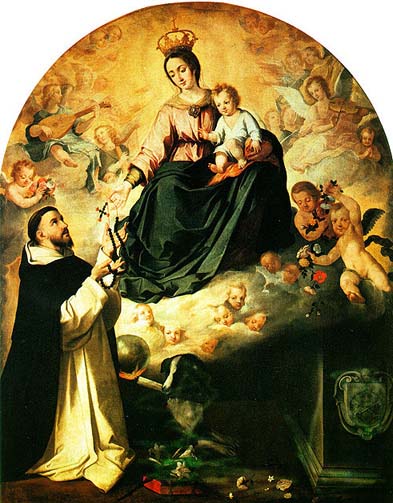
Did Mary give the Rosary to Saint Dominic? Catholic tradition states the Blessed Virgin Mary directly and personally instituted the Holy Rosary through Saint Dominic. A previous post described the traditional account of “How Mary Gave the Rosary to Saint Dominic.”
In this second post we examine the historical-critical objection claiming that the Rosary was an organic development of medieval piety and that Mary did not directly give the Holy Rosary to St Dominic.
Dominic Receiving Rosary
I believe this modern claim is incorrect and too simplistic. It’s perfectly reasonable to believe that Mary gave the Holy Rosary to Saint Dominic. Here’s why…

The Claim Against Mary Giving the Rosary

First, let’s examine the modernist argument against the Marian origin of the Holy Rosary. Some moderns hold that the traditional account depicting Mary giving the Rosary directly to St Dominic is a pious etiological myth. This myth, they say, allegorizes the origin of the Rosary with the Dominican order.
The “true” story, the moderns claim, is that the Rosary was a gradual and historical development. They say that since the Dominicans popularized the Rosary devotion, the traditional myth personifies the Dominicans in the person of Dominic. So then, the moderns allege that the Blessed Virgin Mary did not directly give the Rosary to Dominic. Rather, the Dominicans popularized the devotion and so Mary “sort of” gave the Rosary to the world through the “sons of Dominic,” i.e. the Dominicans.
These moderns observe that the practice of praying Our Father’s and Hail Mary’s on beads is a practice that predates Saint Dominic, and that this “Rosary” gradually evolved. This fact, they claim, further substantiates the conclusion that the Holy Rosary is not a revealed gift given directly to Dominic by the Blessed Virgin Mary herself.
While it is certain that many (East and West) prayed on beads prior to Saint Dominic, the original claim is that the Holy Rosary as a collection of 150 Hail Mary’s with the 15 Mysteries (Joyful, Sorrowful, Glorious) was literally and historically given to Saint Dominic by the Immaculate Mother herself.

Summary of Points So Far:

1) Moderns claim that the tradition of Mary giving the Rosary to Dominic is an etiological myth.
2) It is true: praying Our Fathers and Hail Marys on beads predates Saint Dominic (in fact, the word “bead” comes from the word “bid” meaning “pray” or “ask”).
3) The key to this debate is realizing that the Holy Rosary is not merely praying on beads, but praying the 150 Hail Mary’s with the 15 corresponding mysteries.* It is this special combination of 150 Hail Mary’s with the 15 mysteries that constitutes the Rosary and it is this “combination” of vocal and mental prayer that Mary gave to St Dominic.

What does the Catholic Church say?

Pope Leo XIII, in his encyclical Octobri mense, teaches that the Rosary does in fact have its origin from the Immaculate Mary herself “by her command and counsel” to Saint Dominic. Pope Leo XIII teaches:
“That the Queen of Heaven herself has granted a great efficacy to this devotion is demonstrated by the fact that it was, by her command and counsel, instituted and propagated by the illustrious St. Dominic, in times particularly dangerous for the Catholic cause.”
Pope Leo XIII also clarified that this original institution of the Holy Rosary by Mary included the Joyful, Sorrowful, and Glorious Mysteries, which he calls the “great mysteries of Jesus and Mary, their joys, sorrows, and triumphs.”
In his Supremi Apostolatus Officio, Pope Leo XIII again confirms the supernatural origin of the Holy Rosary of Saint Dominic:
Great in the integrity of his doctrine, in his example of virtue, and by his apostolic labors, he proceeded undauntedly to attack the enemies of the Catholic Church, not by force of arms, but trusting wholly to that devotion which he was the first to institute under the name of the Holy Rosary, which was disseminated through the length and breadth of the earth by him and his pupils. Guided, in fact, by divine inspiration and grace, he foresaw that this devotion, like a most powerful warlike weapon, would be the means of putting the enemy to flight, and of confounding their audacity and mad impiety. Such was indeed its result. Thanks to this new method of prayer—when adopted and properly carried out as instituted by the Holy Father St. Dominic—piety, faith, and union began to return, and the projects and devices of the heretics to fall to pieces.”
The tradition is further confirmed by the apparition of the Immaculate Mary to Blessed Alan de la Roche:
 My son, you know perfectly the ancient devotion of my Rosary, preached and diffused by your Patriarch and my Servant Dominic and by his spiritual sons, your religious brothers. This spiritual exercise is extremely agreeable to both my Son and to me, and most useful and holy for the faithful.  When my Servant Dominic started to preach my Rosary … the reform in the world reached such heights that it seemed that men were transformed into angelic spirits and that Angels had descended from Heaven to inhabit the earth. … No one was considered a true Christian unless he had my Rosary and prayed it. … The prestige of the holy Rosary was such that no devotion was or is more agreeable to me after the august Sacrifice of the Mass.”
As discussed elsewhere, the three apparitions after the Miracle of the Sun also symbolize the three mysteries of the Holy Rosary: Miracle of the Sun Symbolizes Mysteries of the Rosary.