Showing posts with label san vicente. Show all posts

Sunday, May 11, 2014

Sila Island: Hidden beach unspoiled, blushing pink.


By 


PRETTY IN PINK Tucked away along the remote coast of Northern Samar province is the Pink Beach of Sila Island. Its pink, powdery sand makes it one of only two pink beaches in the country. Its color comes from the mixture of fragments from red corals and shells pulverized by waves over thousands of years and washed ashore to mix with the original white sand grains. Sheltered by a reddish rock wall, Pink Beach assumes shades of red or salmon when the sun is at its hottest. CONTRIBUTED PHOTO/Quirino Denzel Real Pajares
SILA ISLAND, Philippines—One of the prettiest beaches in the Philippines is tucked along the coast of Northern Samar province, away from prying eyes, nosy and noisy beach bums, and greedy tourist trap operators.
The pink, powdery sand beach is surrounded by sparkling waters that alternately turn emerald green and turquoise. Coconut trees swaying in the gentle breeze dot the seashore. Black rocks and unusual stone formations separate the pink beach from its neighbor, a privately owned beach of white but not-as-fine sand.
There is only one other beach covered with pink sand—albeit more famous—in the country, and it is found on Great Santa Cruz Island in Zamboanga City.
Located on the eastern side of the island village of Sila in San Vicente town, Northern Samar, Pink Beach is a 92-meter-long and 8-meter-wide stretch that has been attracting tourists all year-round, especially during summer when the sand’s pinkish hue is more evident.
Shades of red, salmon
“When  it is exposed to the sun, the sand is tinted in shades of red or salmon. The best time to be in Pink Beach is during summer when the sun is up,” said San Vicente Mayor Tito M. Luñeza.
Luñeza is one of the owners of the property that sits on a 4-hectare coconut plantation, which he and his siblings inherited from their parents.
Last April, the Luñezas built one bamboo kiosk and two toilets for Pink Beach visitors. “Maybe we will build two more kiosks because many people have been coming over. We have no accommodations yet but we have allowed campers to pitch their tents, as long as they help clean the area before they leave,” he said.
The beach is sheltered by a rock wall with a reddish hue that separates it from the main village of Sila where about 250 families reside, most of them former natives of Cebu province. Although Cebuano is the dominant language spoken, there are a few settlers who speak Waray.
One has to climb a narrow pathway and walk another 30 minutes to reach the other side of the island. Another way is to take a boat to the main village.
Corazon Lañuza, the mayor’s cousin and caretaker of the beach, said the color of the sand has always been pink, even when she was a little girl.
Why it’s pink
The color comes from a mixture of fragments from red-colored corals and “foraminifera”— tiny sea creatures with red shells that are washed ashore during the “habagat” (southwest monsoon) season.
With the passage of time, the corals and the red shells are pulverized by the waves and other elements, and mix with the original white sand grains, resulting in the sand’s pink color.
San Vicente is an island town composed of seven islands of the Naranjo Island Group, with a population of 7,447, according to the 2010 census. A sixth class municipality (annual income less than P15 million), it used to be part of nearby island-town of Capul. San Vicente used to be called Barrio Mongolbongol (Destacado Island) of Capul until it became a town on June 18, 1966, by virtue of Republic Act No. 4761.
Apart from Sila, six other islands form part of San Vicente: Sangputan, Destacado, Panganoron, Maragat, Medio and Tarnate.
The town got its new name from its patron saint, St. Vincent de Ferrer. Its seat of government is in the island of Destacado.
Well worth the long trip
Fishing is the main source of livelihood, although many residents also earn from copra because coconuts are abundant in San Vicente.
It is not easy to go to the island from Tacloban City, Leyte province, but the trip is well worth the trouble.
The four-and-a-half-hour drive to Calbayog City from Tacloban on board a van-for-hire will cost the passenger P250 per person. From Calbayog, you need to take another van that will take you to San Isidro town in Northern Samar, the jump-off point to San Vicente.
There is only one boat plying the San Isidro-San Vicente route that leaves at 2 p.m. daily except on Sunday, which is a rest day for many of its residents.
The boat leaves the pier in San Vicente at 7 a.m. daily, with the fare  pegged at P100 per passenger. Tourists, however, can rent the entire boat at the rate of P7,000 to P9,000 for a one-way trip. But there is no motorboat that sails directly to Sila Island because tourists have not come on a regular basis.
No stores
The travel time from San Isidro to Pink Beach is 45 minutes. There are, however, boatmen willing to bring tourists on motorized boats at P5,000 for a two-way trip.
Since there are no stores on Pink Beach, hungry visitors have to go to nearby Ternate village for its wide variety of seafood—from fish and squid to crayfish, which is sold at P1,200 per kilogram, a bargain compared to the P3,000 to 5,000 per kg available in most restaurants.
Even if going to Pink Beach can be a challenge, a growing number who have learned of its fabled pink sand have taken the dare and shown up, ready for adventure.
Who could blame them from coming over?
Apart from the pink sand, the sight of flying fish welcoming the visitors would be hard to resist. And the colorful reefs are a feast for the eyes.
There is no entrance fee but anyone can donate their extra pesos to the caretakers who clean up the beach after the visitors have gone.
Snorkeling, scuba
Although there are no available recreational facilities, there are a number of activities one can do: meditate, walk around, get a tan or swim to your heart’s content. Snorkeling or scuba diving are must to-dos. You can collect shells but be sure not to bring any of that precious pink sand home. A reminder written on a huge rock on the beach warns visitors:  “Gui Dili pag Kuha ug Baras (Not allowed to take Pink Sand).”
Despite its potential, the Department of Tourism (DOT) has not gone full swing promoting Pink Beach since it is not yet ready to accept the influx of visitors, said Karen Tiopes, DOT director for Eastern Visayas.
She pointed out that the town and Pink Beach lack facilities and accommodations, although there are several homes in San Isidro that accept tourists at a friendly rate of P150 per person.
For sale
The Luñezas also want to sell Pink Beach, admitting that they don’t have the capital to develop the property. “There are many takers, mostly diving resort owners, but we cannot agree on the price,” said Mayor Luñeza.
Kookai Sultan,  officer of the Department of the Interior and Local Government assigned in San Vicente, said the agency had approved two fish and marine sanctuaries in San Vicente under the Bottoms-up Budgeting program. One is near the pier of the poblacion up to the Pasil islet. Another will be set up between Pink Beach and nearby Panganoron Island.
Sultan said that once these sanctuaries are in place, the mayor might have second thoughts about selling the property because these are tourist come-ons that can also increase fish production in the area.
But for its awesome pink sand feature alone, without a doubt, Sila Island’s Pink Beach is definitely a crowd-drawer.
For your retirement and other real estate needs, please visit http://www.gregmelep.com.

Friday, April 4, 2014

San Vicente beaches hidden but not for long


By 

 112 2946 2712

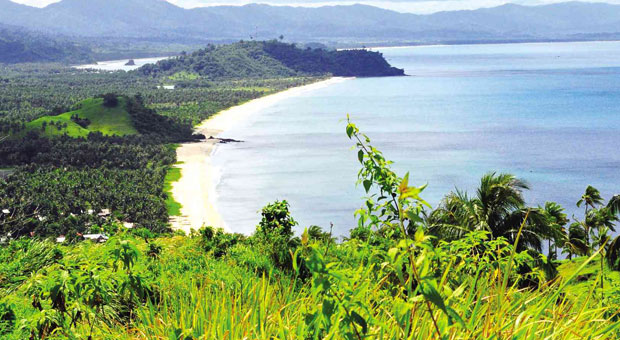
LONG BEACH This 14-kilometer stretch of shore covered with powdery white sand in San Vicente town, in the island province of Palawan, promises to become one of the Philippines’ top tourist destinations, as development continues involving the tourism industry’s big investors. PALAFOX ASSOCIATES/CONTRIBUTOR
The Inquirer is running a series of articles on the country’s tourism crown jewels—somehow uncut but equally sparkling and surprising as the usual vacation haunts. The stories will appear three times a week during the summer months. Please send us your own hot go-to discoveries to summer by. Text 09178177686 for details.–Ed.

SAN VICENTE, Palawan—Imagine trekking along 14 kilometers of unspoiled powdery white sand with nothing but the vast expanse of the West Philippine Sea and endless rows of lush forests and old coconut trees on both sides.
If you insist on been-there-done-that bragging rights, Palawan province’s Long Beach should top your list even before the first hotel hove into view and upbeat party music supplanted poignant evenings.
It’s easy to tell this place is going to transform in a big way.

A 2-km-runway airport nearby is due for completion this year and promises to dramatically boost tourist traffic. The cementing of the access road from the capital of Puerto Princesa City, or what used to be a decrepit logging road through old growth forest, is just about finished and will effortlessly link the place to the urban hub.
Most notably, the tourism industry’s big guys are already on board. They have figured this place out long before the first backpackers wandered into it. Among them was Anscor, which is into high-end island-resort development. They have locked in the prime locations along Long Beach, pouring in an estimated P1 billion in acquisitions in the last five years, according to local officials.

“There is no doubt that Long Beach is destined to become a world-class tourist destination. With its 14.7-km-long pristine stretch of beach, it is one of the longest, if not the longest, white-sand beach in the Philippines,” San Vicente Mayor Pie Alvarez told the Inquirer.

Alvarez is presiding over a meticulous planning process, which she hopes will ensure that tourism development can take place in Long Beach with optimum benefits to the local economy, “without sacrificing the environment.”
“We wish to learn from the best practices of tourism destinations around the world and create our own unique destination,” Alvarez said.

Natural beauty

Long Beach is a seemingly endless stretch of sand that arches along the western coastline of Palawan. From one’s seat as the plane descends, one can’t miss the glistening strip of sand at the edge of the lush forests of central Palawan. As one stands from one end of the beach, it is hard to see where it ends even on a clear day.
San Vicente’s planners can’t resist the comparison to Boracay Island in Panay that currently draws the bulk of beach hounds in the country. By its sheer size, Long Beach is Boracay magnified four times.

“One of our advantages is we have the opportunity to plan first before we build,” said municipal tourism officer Lucy Panagsagan.

The local government has a good reason to be cautious on how they should go about exploiting the area. Despite being the main hub of a logging operation in the late ’70s, San Vicente remains the most densely forested area of Palawan, with 86 percent of its total land area still covered by trees.

Its marine environment is host to an abundant fisheries resource. The town wants to make sure the fish remain, so they have designated at least six sites as fish sanctuaries or no-take zones.

A large chunk of the forest has been classified as a protected area under the National Integrated Area Protected Program. Nearly all wildlife species in the province can be found in San Vicente, including those considered to be at the brink of extinction such as the Philippine forest turtle (Heosemis leytensis), which can’t be found anywhere else in the world.

Land prices

Long-term investors from Manila and Cebu started the ball rolling for choice slices of real estate along Long Beach just over five years ago. Locals sold their land for as low as P70 per square meter, recalled Francis Picardal, a local entrepreneur.

Vice Mayor Antonio V. Gonzales recalled that at one time in 2007, he facilitated the acquisition of prime Long Beach properties for five prominent businessmen from Cebu province who shelled out P5 million each.

“In 2007, the landowners were happy to sell at P100 per square meter. These days, the price is between P4,000 to P5,000 per square meter,” Gonzales said.

Except for a handful of families, most of the original owners of the land, including the Agutaynen natives of San Vicente, have sold out to developers from out of town.

“It’s a sad reality that the original landowners were not able to hold on a bit longer to their properties,” Picardal said.

Getting there

Getting to San Vicente these days still requires an attitude most often alien to the soft-heeled. The interior roads from Puerto Princesa City are rough and travel can take as long as four hours.

San Vicente, at the moment, is still a backpacker’s delight. One can hop into an iconic rural bus usually packed to the roof, take a more comfortable shuttle service at P300 per passenger, or hire a van from Puerto Princesa City for somewhere between P6,000 and P7,000 per day.

The town proper is dusty to rustic and the only way to get around if one doesn’t have one’s own vehicle is to ride a habal-habal, a motorcycle with a slightly extended backseat for another passenger (or more, as is often the case).

Tourism master plan

The municipal tourism office lists just about 48 bed accommodations available in the town proper, mostly family-run lodging facilities made of light materials. One German entrepreneur with a Filipino wife built a hotel at the edge of town toward Long Beach that offers more familiar amenities, including a Wi-Fi connection and an infinity pool looking out into the ocean. Lodging rates range from P1,500 to P3,500 per day.

Last week, Palafox planners submitted to the municipality of San Vicente a draft tourism master plan. Among their major recommendations was to set a 50-meter exclusion zone from the high tide line of Long Beach, a distance twice the usually prescribed 25-meter no-build zone for coastal development.

The potential as a nature attraction is huge, according to the planners. Among the activities that could attract investors and visitors are windsurfing, surfboard riding, scuba diving and snorkeling, mangrove tours, rainforest treks, bird watching, island hopping, camping and sightseeing.

Gonzales said they would institutionalize their master plan by legislating their tourism master plan through an ordinance. It is the bible that property developers like Anscor, Big Foot Inc., Discovery Shores and other key tourism players have been waiting for so they can make their move.

For starters, Gonzales said, Tieza, the government’s tourism infrastructure arm, “is helping us in a major way”and has committed to help fund the completion of the town’s drainage plan and other turnkey infrastructure requirements targeting Long Beach.

“That’s what developers are waiting for. Once we have these things in place, development will naturally follow, Francis Picardal, a local lodge owner, said.

San Vicente had also enlisted in the Climate Change Commission’s “Ecotown” program to develop its own preparedness to confront nature-induced calamities brought about by changing weather conditions.
Ecotown consultant Dr. Antonio Carandang said the approach being taken by the municipality should help avoid the problems faced by other places that cater to large volumes of tourists.

“If carefully planned, Long Beach could be less commercial but more orderly and may surpass Boracay in terms of attracting high-end but environmentally aware tourists,”he said.

Mayor Alvarez insists they are not particularly intent on following Boracay’s development model, stating that it is more important for them to brand Long Beach as a unique destination that is world-class.

“Boracay is an already established world-class destination. We do not wish to compete but instead take the best practices and lessons learned from their tourism development methods. We hope we can create a destination that the Philippines can be proud of, always keeping in mind a holistic approach that balances community, development and the environment,”she said.

LONG BEACH FAST FACTS

Location: San Vicente, northern Palawan; southern part of Imuruan Bay, northern part of Pagdanan Bay
Distance from Puerto Princesa City: 186 kilometers

Accessibility: 3 to 4 hours land travel time from Puerto Princesa City; private van rentals from the city at P5,000 to 6,000 one-way

Characteristics: 14 km long

Attractions: Daplac Cove, Capari Cove Coral Reefs, Mangrove Forest, Wilson Head, Double Island, Naparay Coral Reefs, Little Baguio Waterfalls

Accommodations: Capari Resort, Peace and Love Resort, Ditchay Bed and Breakfast, John Eric Lodging, Picardal Lodge, Bahay ni Kuya, Station 5, M&D Resort, Nayarani Vilas

For your retirement and other housing needs, please visit http://www.gregmelep.com