Showing posts with label vegetables. Show all posts

Sunday, June 15, 2014

Rice farmer hits P1-M income thru diversifying


Science City Of Muñoz, Nueva Ecija — Ernesto Romero goes around town driving a Mercedez Benz. Aside from his luxury vehicle, he owns a six-hectare residential lot and a warehouse. At times, he earns P200,000 a week.
Mang Ernesto is no city big shot or big-time investor, but an industrious farmer who, at the age of 76, looks after his investment well with his hands literally in the dirt.
Ernesto Romero, Manila Bulletin
Ernesto Romero
At his age, he takes pride in his achievement of being a “rich” farmer. Many Filipino farmers fall way down in the low-income earner bracket.
But Mang Ernesto became a millionaire with hard work, perseverance, industry and, yes, a little help from PhilRice to maximize the productivity of his farm land.
Who would have thought his four-hectare farm in Talavera, Nueva Ecija turned up a big profit through a variety of plants he had planted. All he planted are income generating like green pepper, calamansi, winged seguidillas beans (sigarilyas), papaya, banana, “malunggay,” and sampaguita flowers.
Mang Ernesto’s farm has become the goose that lays the golden egg. The income he derives from one hectare, planting the crops, is the same as the income he used to get from a four-hectare rice farm.
PhilRice Executive Director Eufemio Rasco said Romero’s experience is proof that farmers can become millionaires if they will optimize the use of their farms, diversifying rice variety and try other enterprises such as mushroom and duck-raising.
There are 365 days in a year, but a rice farmer only works about 110 to 220 days, giving him 145 idle days. The remaining days can be used to grow other crops like fruits and vegetables.
PhilRice has been spreading the gospel of sustainable, ecologically efficient and socially acceptable production system through Intensified Rice-Based Agri-Bio System (IRBAS) – which is capable of giving farmers a gross income of at least 1 million per hectare per year.
IRBAS is the system whereby all components of the rice plant can be used to produce other products.
“If the farmer uses rice by-products such as rice hull and rice straw for producing mushrooms, fertilizer, feeds, and energy, among others, then a million income is attainable,” Rasco said.
For your retirement and other real estate needs, please visit http://www.gregmelep.com.

Wednesday, April 23, 2014

Visiting chefs from Denmark get creative with ‘ube,’ ‘ buko,’ ‘calamansi,’ mangoes


By 


 0 2 0


STEAMED diwal with sigarilyas
A good meal needs time to be digested in the mind.
It took a while for me to figure out what was learned from the dinner with two visiting chefs—Yannick van Aeken, former sous chef of Noma, and Louise Bannon, currently Noma pastry chef. (Noma in Denmark was ranked best restaurant in the world from 2010 to 2012 by the British magazine Restaurant; Noma’s chef, Rene Redzepi, is known for foraging the ingredients for his dishes.)

Chef Roby Goco of Cyma and his brother, Pio, took charge of setting up the venue for the dinner, inviting the guests, and sourcing the menu’s ingredients, most of them organic—the selling point of Roby’s other restaurant, Green Pastures at Shangri-La Plaza.

Nothing can be as fresh as foraged ingredients. But on unfamiliar grounds, the public market is the best place to do that. For Van Aeken, the kinds of ingredients in this country overwhelmed him. But why is it, he asked, that we have few vegetable dishes?

He knew that right away by just reading the menu wherever they ate. There are, he said, many chicken and pork dishes. I told him that I had asked myself that same question. But I also
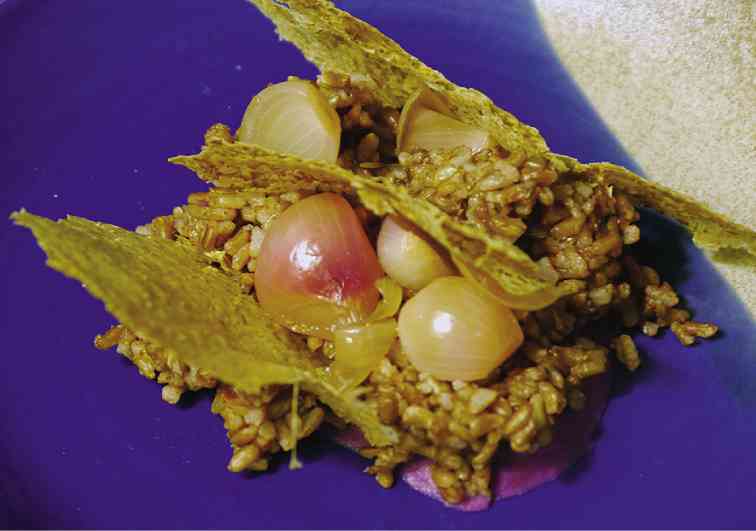
OATS, brown rice and Nordic biscuit called kiziek on a bed of mashed ube
informed him that in Ilocos, people have more appreciation of vegetables and they cook it with simple means.

He and Bannon, however, went south to the Visayas and incorporated some of the ingredients found there into the dinner menu. The dinner guests couldn’t be kept out of the kitchen where Bannon was cutting mangoes for dessert. Both chefs said the fruits here were the best they’ve had. If they visited a month later, in May, Philippine mangoes are at their sweetest.

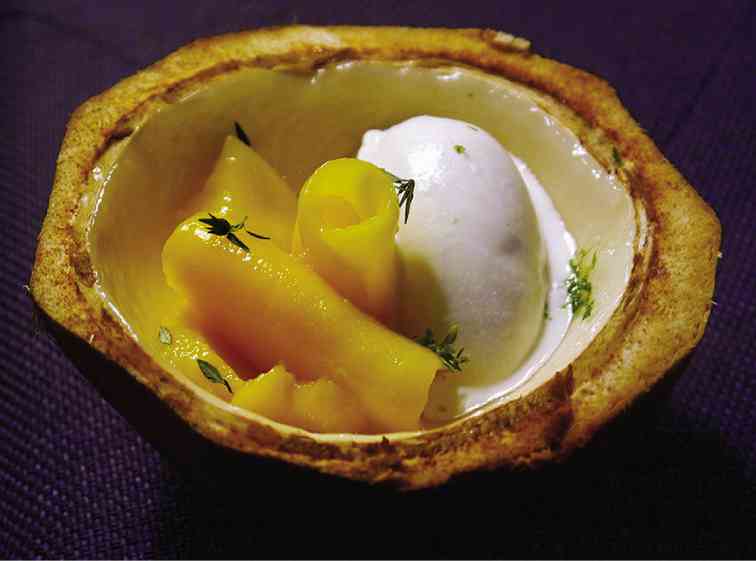
The mangoes for dessert came with coconut ice cream flavored with buko, calamansi, and mango juices. It was simple, and the ingredients were all that mattered.

Mix and match

That dinner reminded me of my family’s Sunday lunch after the husband goes to market. He always says that what he buys has already been cooked in his head. The apahap (sea bass) is steamed. The crabs are fried, then cooked in a Chinese ginger sauce. The salay-salay is prepared as kinilaw.

COCONUT ice cream with mangoes
Van Aeken and Bannon must have been thinking like my husband when they went through the wet market.

First bowl out of the kitchen had diwal (angel’s wings), always impressive if you know you can’t find this anywhere.  The shellfish was steamed, accompanied by sigarilyas (winged bean) with a hint of calamansi, vinegar and pickled shallots.

A thick sauce made of squash held mussels with ar-arosep (grape-like seaweed) and some chicharon. It was sweet and salty, with texture. It really says that you can mix and match varied ingredients, but you must also know how each ingredient contributes to the whole.

Next was a Japanese dish—a broth of dashi, a chef-perfect poached yolk, seaweed and daikon cubes, and malunggay (moringa) leaves still on their stems.
I wondered, when can we identify something as a truly Filipino dish?

Anyway, the succeeding menu item had mashed ube as the base, and over it were oats, organic brown rice, shallots and a Nordic biscuit called kiziek. Of all the dishes, I think this was the strangest in terms of combination—grains with ube.

The last dish was quite strange yet familiar—cabbage with tomato sauce flavored with tinapa (smoked fish). It recalled a similar sauce that my family used to do with boiled cabbage. We
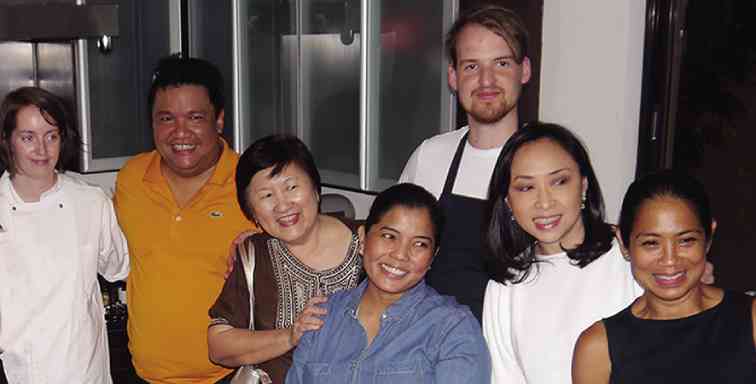
FROM LEFT: Noma pastry chef Louise Bannon, chef Roby Goco, Micky Fenix, Aleth Ocampo, chef Yannick van Aeken, Heny Sison and Margarita Fores
never had it on my lola’s table, so it must have been something my mother had read about and decided to include in our menu ages ago.

Back to basics

Many of the dinner guests were probably expecting high-end restaurant dishes that they imagine Noma would serve. But it all boiled down to having fresh ingredients, with a minimum of processing.

After sous vide and molecular gastronomy, going back to the basics may seem such an elementary exercise. But that’s exactly what we should taste—food with ingredients that have not been cooked to death. Especially vegetables.

E-mail pinoyfood04@yahoo.com

For your retirement and other real estate needs, please visit http://www.gregmelep.com.