Friday, April 4, 2014

Cash-crop condominiums.


By 


 86 3240 2958
When we tell the stories of our wealthiest men, we tend to tell the stories that are of no consequence: We repeat their names, which have generally remained constant for most of recent memory; we futilely recite the numbers of their net worth; and we mythologize the secrets to their success.

These stories are of no consequence for the simple fact that we are telling ourselves things that we either already know, or things we don’t need to know.

When we dwell on who the 10 Filipinos on Forbes magazine’s  2014 list of world billionaires are, we learn nothing of value. Henry Sy’s net worth is a few hundred million dollars lower this year, the Ayalas are mysteriously absent, the majority of the names are Chinese-Filipino. So what?

Significance

But once we turn our attention to understanding what the richest Filipinos are, an entirely different story reveals itself. The true significance of the recent fortunes of our 10-millionth percent is in how their stories can help make sense of the puzzles of our recent economic successes, such as jobless growth, our inability to address deep and widespread poverty, or whether the near future holds an East Asian-style “takeoff” in the Philippines.

To tell this other story, we need to ask different questions: How are the biggest Filipino capitalists building their fortunes? Why, in the Philippines of the 21st century, is wealth being built in this way? How does this strategy compare with those seen in other periods of our economic history, or in other places? Finally, what does the success of this strategy mean for the prosperity not just of the few, but of the country as a whole?

The more things change …

Let’s begin by describing what Philippine capital isn’t. Seen in historical perspective, one thing is immediately clear—the biggest and most successful Filipino capitalists of today aren’t the caciques, taipans and crony capitalists of yesteryear.

Cash-crop export, the bulwark of the landed cacique class, has been in terminal decline for 40 years. A a series of crises—beginning with the end of privileged access to the US market for our sugar exports in 1974, depressed world prices for sugar and coconut in the early ’80s and the mismanagement of monopolies created during the Marcos regime—has steadily eroded the viability of this modus operandi.

Net agri importer
More recently, commitments entered into by the Philippines under the World Trade Organization, as well as in bilateral and regional free-trade agreements have rendered Philippine agriculture susceptible to competition from cheaper, often subsidized, agricultural imports.

As a consequence, we are running an agricultural trade deficit with 11 out of our 16 free-trade “partners,” have been a net agricultural importer since the mid-’90s and our agricultural products have dwindled to less than 1 percent of our total exports.

Domestic manufacturing has fared just as badly. The tariff- and quota-based protection schemes erected to develop a domestic industrial capability, upon which the taipan class had built its wealth, have been dismantled by three decades’ worth of structural adjustment and trade liberalization.

State-owned enterprises, set up as nuclei for Philippine industrialization, have been privatized without even fulfilling their original mandate. Meanwhile, the crony capitalists who ran them were mostly unable to leverage dictatorial largesse into lasting dominance over the economy. Factories, plants and in some cases entire industries were shuttered in the ’80s and ’90s, even as the tiger cub economies of Southeast Asia rode a wave of Japanese investment to industrialization.

And while the Philippines did succeed in developing an export-oriented electronics industry in its special economic zones (SEZs), participation by domestic capital has been insubstantial—other than, of course, in the development and administration of the zones themselves.

Structurally impossible

All told, it is now structurally impossible for Philippine capitalists to amass fortunes on either the backs of peasant labor or from a protected domestic market. With some exceptions, they have not developed the competencies for export-oriented industrialization. They now find themselves in a situation that stands in stark contrast to the ’50s and ’60s, when the wealthiest Filipinos were almost invariably sugar barons and when the upper echelons of Philippine politics were drawn from their ranks.

This situation is also markedly different from the ’70s and early ’80s, when an ersatz industrial capitalist class propped up by the Marcos regime dominated the economy. Finally, it also bears no resemblance to the high-tech, export-oriented “tiger economy” envisioned by the high priests of neoliberal reform in the ’90s.
Yet, they are obviously doing quite well. How?

Back to land

Land, which has long been the most important reservoir of money and power in Philippine society, has reemerged as the cornerstone of Philippine capital’s strategy for the 21st century. But instead of tobacco, sugarcane and coconuts, the new cash crops are condominiums, office towers and malls.

The new Philippine economy is seeing billions of dollars churned into the land by overseas Filipinos buying new homes, services outsourcing firms renting office space and mall operators cashing in on the newfound consuming power of the globalized middle classes.
Over the past decade, real estate has consistently been one of the best-performing subsectors of the economy: Data from the National Statistical Coordination Board (NSCB) show that, if considered separately from ownership of dwellings, the gross value added of real estate expanded at a clip of 141 percent from 2000 to 2010. This was more than double the pace of gross domestic product growth in this period and was second only to mining among the subsectors tracked by the NSCB.

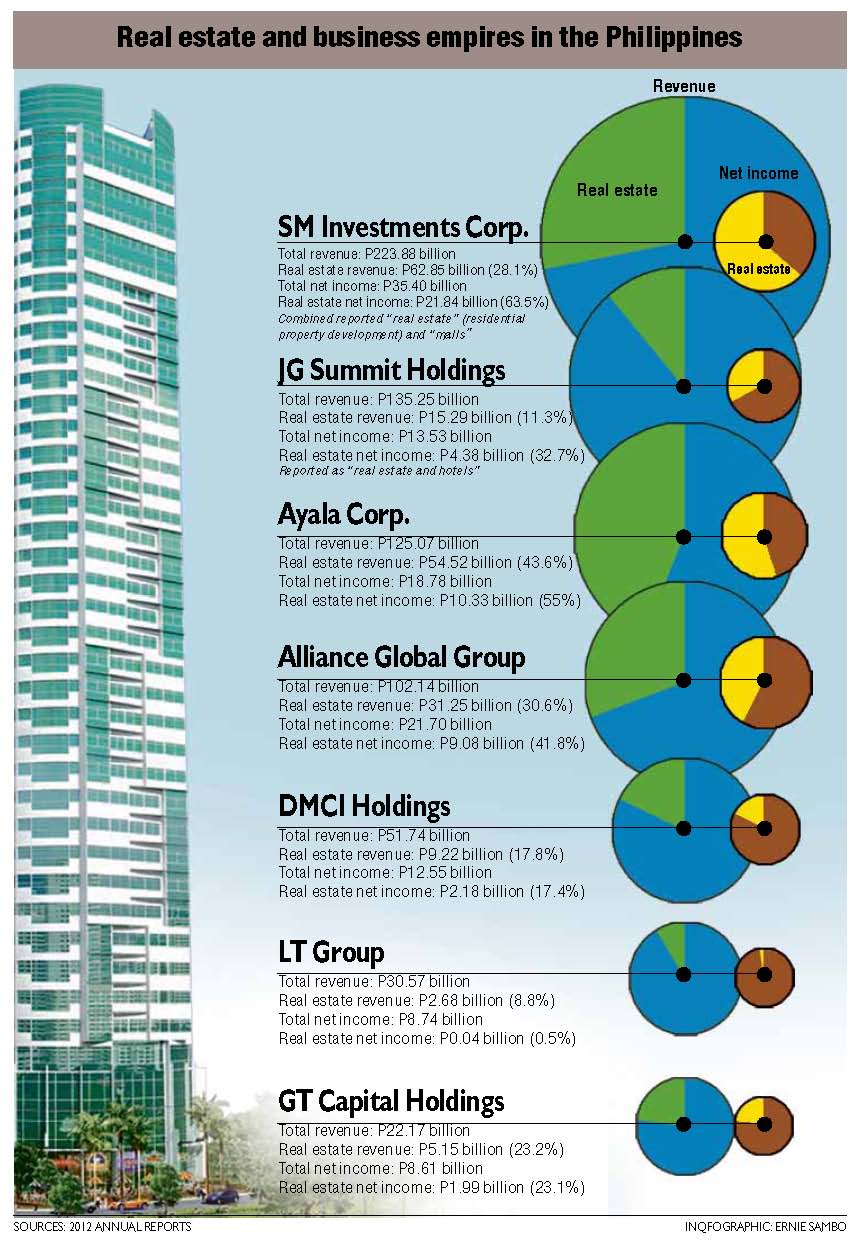
Much of this growth, in turn, was captured by the big, family-owned conglomerates that dominate the economy. They have converged on urban real estate as a strategy for diversifying from their mainstay businesses. Indeed, among the 10 Filipinos on Forbes’ 2014 world’s billionaires list, nine have significant stakes in real estate. (See table.)
Most of the real estate companies owned by the richest Filipinos are fairly new to the game. Only Andrew Gotianun (Filinvest), Manuel Villar (Vista Land and Lifescapes) and Jose Antonio (Century Properties) built their fortunes on real estate, while the rest had zero or minimal interests in property development until recently. And despite being new entrants, these conglomerates have demonstrated a remarkable savvy for it.

SM Development, which began developing residences in 2003, is now the largest property developer in the country. Megaworld, the second-largest developer, completed its first project in 1994. By 2011, it held 13.1 percent of the market. In many cases, their property development arms now outshine the rest of their portfolios, delivering outsized shares of their net incomes. (See infographic.)

Creative destruction

If their fluff profiles are to be believed, the success stories of our capitalists are a simple matter of sipag at tiyaga (industry and patience), business acumen and favorable alignments of the stars. But perhaps it is Shiva, the Hindu deity of creative destruction, to whom our billionaires really owe their recent good fortune. The same forces of neoliberal reform that rendered the old strategies unviable were also creating new opportunities for wealth creation.
The mass exodus of Filipino workers unable to find jobs in our structurally adjusted homeland would eventually grow into a multibillion-dollar-remittance powerhouse.

The aggressive perks granted to economic zone locators and the eventual relaxation of rules that allowed single buildings to be declared information technology SEZs created demand for greenfield industrial zones in southern Tagalog and office space for service outsourcing locators—first in Manila’s business districts and then to “next wave” cities across the archipelago.

Liberated from old economy

Finally, thousands of hectares of urban and peri-urban land, whether in the form of privatized state assets, rice fields deliberately idled by their owners and reclassified to avoid agrarian reform, or brown-field sites of shuttered factories, silos and warehouses, were being liberated—sometimes violently from farmers and the urban poor, often at an unfair price to the Filipino people—from the old economy.

At this point, the prize was simply theirs for the taking. Unlike other sunshine industries, such as electronics manufacturing—or, to a lesser extent, services outsourcing—the technical barriers to entry for property development are minimal, especially if competencies in construction, sales and marketing, and banking were previously developed. Yet, other barriers ensured that only a very select few could salvage the flotsam from the old economy.

The first major barrier is the ability to marshal large sums of capital that was necessary to bid successfully for large, winner-take-all privatizations, or to snap up large tracts for “land banking.” This insulated these companies’ operations from competition from smaller firms.

Limited foreign ownership

But perhaps the decisive advantage to these conglomerates, whether by accident or by design, was conferred by the national patrimony provisions of the 1987 Constitution, which limited foreign ownership of private land to 40 percent of total equity. They were thus protected not only from smaller domestic competitors but also from the more significant threat of foreign capital.

The same logic goes some way to explaining the pattern of diversification that we are seeing among our biggest conglomerates. The sectors that have attracted intense investment by domestic capital, such as banking, retail, airlines, energy, infrastructure, retail, utilities, and most recently, hospitals and schools, are all afforded some measure of protection from foreign competition, and involve businesses that are beyond the reach of most Filipino entrepreneurs.
Lest this be read as an argument in favor of the total relaxation of foreign ownership restrictions: It is not. If anything, the success of Philippine capital in building empires in sheltered sectors should be interpreted as a vote of confidence for the state intervening to create “national champions,” the globally competitive, export-oriented firms that were key to the economic miracles of East Asia.

Indeed, some of the businesses that have thrived under protection have emerged as unlikely and unintentional national champions: SM malls, which began expanding internationally in 2001, and Cebu Pacific, which is the third-largest low-cost carrier in Asia.

‘Keiretsu’ or ‘chaebol’

But will our national champions deliver the same kind of economic transformation seen in Japan and South Korea? In other words, if they aren’t caciques or taipans, are they keiretsu or chaebol?

It matters that much of our recent growth has been in property development and that Philippine capitalism has gone back to the land, because not all forms of economic growth have the same implications for the development—or maldevelopment, or even underdevelopment—of the country.

For industrial capitalists, the two main rules are keeping the rates of profit high and preventing gluts in the market. At the risk of gross oversimplification, Japanese and Korean capital had a stake in thoroughly industrializing their economies and creating a strong middle class because they needed both a cheap and efficient supplier base to keep costs down and consumers to buy their products.

In contrast, property capitalists need to create liquidity out of land, an inherently illiquid, immobile asset, fixed in space and (by virtue of its long turnover cycle) in time. As a breed, they have no vested interest in a large, well-paid industrial workforce. What they do need is to find high-margin markets with quick turnarounds and to ensure that their investments can be readily converted into liquid and globally mobile financial assets.

As luck would have it for Philippine capital, the high-margin, quick-turnaround markets (overseas Filipinos and services outsourcing) exist, are delivering seemingly insatiable demand and are paying in dollars. It also happens that their real estate operations have strong intraconglomerate ties with their banking operations, allowing money made in the property boom to be circulated into other speculative investments, both in the country and overseas, at a moment’s notice.

Casino capitalism

So, at least for the time being, they can let it (chips) ride. But as the recent global crisis demonstrates, casino capitalism is a risky game: Bubbles can pop, assets can suddenly devalue and flighty portfolio investments can evaporate overnight. These possibilities have been detailed elsewhere, and bear no repetition here. Instead, we need to devote attention to even more disturbing possibilities, hinted at by the incongruity between the success of Philippine capital and our impressive headline figures on one hand, and the seeming intractability of joblessness, hunger and destitution that many Filipinos face on the other.

Consider the following: Do the recent successes of Philippine capitalists mean that they neither need to industrialize our economy nor to develop a large middle class in order to turn handsome profits? Do their foreign expansions and acquisitions mean that they can go gallivanting in overseas markets without the need to reinvest wealth in our society? Under these conditions, can the Philippine economy really take off?

Told in these terms, the success of our billionaires makes for an even more incredible tale. The story of what our capitalists are—lurking between the lines of the reverential biographies, the lifestyle section prattle and the junk food statistics—is the story of the domestic capitalist class reinventing and reasserting their power, despite the erosion of their traditional bases of accumulation, despite their failure to transition into export-oriented manufacturing and despite conditions of persistent, grinding misery for the majority of Filipinos.

(Kenneth Cardenas, formerly an assistant professor of sociology at UP Diliman, is a Ph.D. student in human geography at York University, Toronto, studying the big business of building cities in the global South. An expanded version of this analysis will appear as a chapter in the forthcoming book, “State of Fragmentation,” to be published by Focus on the Global South.)


For your retirement and other housing needs, please visit http://www.gregmelep.com

Magic of Mercedes’ 7-island paradise


By 


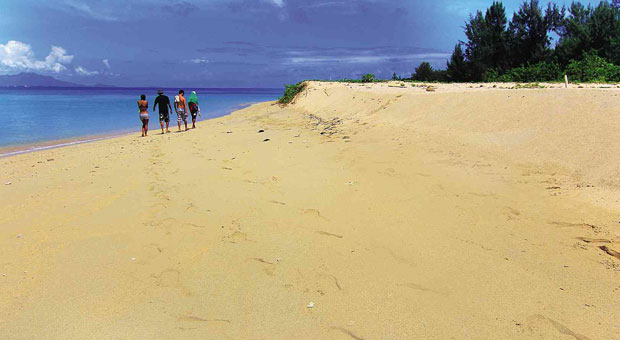
BEACH EXCURSION Children enjoy the fine sand and calm waters on Canimog Island, one of the seven wonders of the Mercedes Group of Islands in Camarines Norte province. The island is adored by backpackers, campers and tourists who are looking for a more daring travel adventure. MARK ALVIC ESPLANA/INQUIRER SOUTHERN LUZON
The Inquirer is running a series of articles on the country’s tourism crown jewels—somehow uncut but equally sparkling and surprising as the usual vacation haunts. The stories will appear three times a week during the summer months. Please send us your own hot go-to discoveries to summer by. Text 09178177586 for details.–Ed.

NAGA CITY, Philippines—Magical may not be the right word to describe the seven wonders surrounded by white sand scattered just off the coast of Mercedes town in Camarines Norte, but it sure comes close to it.

Located at the east of Camarines Norte, the Mercedes Group of Islands is a wonderland of white sand with a surprising abundance of pine trees and protected fish and coral sanctuaries, just a one-hour boat ride away from the mainland.
It is now being touted by locals and its municipal government as the next big attraction in Northern Bicol, Coleen Ibasco, Mercedes Tourism Officer, said.

The islands of Caringo, Canimog, Apuao Grande, Apuao Pequeña, Canton, Quinapaguian and Malasugui are offered as an adventure package that would include excursions to its white-sand beaches, mountain hiking and trekking, boating and kayaking and snorkeling, she added.

Although it has not yet attracted enough publicity, Mercedes’ seven-island paradise is a favorite of backpackers, campers and tourists who seek to experience a different travel adventure apart from beachcombing and indulging in extreme sports like kite-surfing that Camarines Norte has in store in Bagasbas Beach and Calaguas Island.
Ibasco said the Mercedes Tourism Office is working with other local government units (LGUs) in the Bicol region to promote the potentials of the Mercedes Group of Islands.

In Naga City, Alec Francis Santos, head of the Naga Arts Culture and Tourism Office, said united LGUs under Naga Excursions (Naga X) are planning on creating a tour package that would involve a trip to the Mercedes islands.

Big 4

The main attractions of the Mercedes tour are the four largest islands of Caringo, Canimog, Apuao Grande and Apuao Pequeña, Ibasco said.

Only two of the islands, Caringo and Apuao Grande, are inhabited by residents.

Despite the rising influx of visitors, the LGUs and residents themselves were able to preserve the islands’ diverse ecosystem, lush mini forests and pine tree groves, Ibasco said.
If you take the route from Mercedes Port, your tour will start with Canimog Island. The route via Palms Farm Resort in Cayucyucan starts at Caringo.

Canimog, the largest among the seven islands, is shaped like a crocodile, thus, the nickname “Crocodile Island.” It has a bat sanctuary and a lush green forest of pine trees and fruit-bearing trees that are home to teeming wildlife.
On top of its highest peak is a lighthouse built in 1927 with a 104-step stone staircase leading to it from the white sand and pebble beach below. The lighthouse was operated by locals since June 26, 1927, until the early 90s, to guide 
fishermen entering the craggy Mercedes coastline.

It used to run on petrol but now operates on solar power.
On the opposite side of the island is a 500-meter white beach. No other manmade structure has been put up there except for the lighthouse.

In Caringo, some 288 households, or about 1,000 residents, maintain the pristine state of the white-sand beaches that surround the island, Caringo village captain Fernando Navales said.
TOURISTS’ CHOICE Canimog Island’s fine white sane and clear waters MARK ALVIC ESPLANA/INQUIRER SOUTHERN LUZON
Fish, coral sanctuary

It is the only other island where visitors can avail of homestay accommodations, apart from Apuao Grande, he said.
A 17.17-hectare fish and coral sanctuary, one of the four fish and coral sanctuaries hugging the Mercedes islands and coastline, is guarded by a group of women who have banded together under the association Samahan ng mga Kababaihan sa Caringo.

One of the women fish sanctuary guardians, Susan Aseron, won for herself and her group the second place in the Outstanding Rural Women of the Philippines competition held in 2012 for their work in keeping the sanctuary safe from 
illegal fishermen since 2007.

Aseron said she received as prize a fiberglass boat from the Philippine Commission on Women.
The women also make delicious jelly (gulaman) made from seaweeds they culture themselves, Navales said. Despite being a healthy delicacy, they do not sell it in the market or mass-produce it since it is purely for home consumption.
Ibasco said they plan to incorporate the making of gulaman from wild seaweed a part of the Mercedes islands experience in a culinary tour that they are developing with the women of neighboring island Apuao Grande.

The oldest house in Mercedes, built in 1920, is in Caringo. It is known as “Dakulang Harong,” or “big house,” and is 
owned by the heirs of Fortunato and Eufemia Ibasco.

Marine ecosystem

The presence of a healthy marine ecosystem gives the seas around the Mercedes islands its turquoise and teal color that remains the same regardless of how deep the water is.

In Apuao Grande, home to more or less 1,000 residents, crabs, fish and livestock are sources of livelihood in the quiet cove that connects the island to Apuao Pequeña.

Pine trees line some 40 hectares of silky white-sand beaches on the part of the island away from the Pacific Ocean perfect for camping and bonfires.

In Apuao Pequeña, a mini-rain forest covers a mountain that is the refuge of fruit bats and wild boar. Pine trees provide cover to the entrance to the forest.

Ibasco said the fruit bats, which can grow to as tall as two feet from tip to tip of its wings, moved in from Canimog after residents began hunting them down.

An hour of hiking to the top of the mountain ends at a stone bench, right in the middle of the island.

The Rock
The Canton Island is called “The Rock” because of its massive rock formations, caves and craggy shores.
Ibasco said it is a favorite of visitors who love spelunking and outdoor rock climbing.
Quinapaguian Island, on the other hand, is a tiny uninhabited island surrounded by white-sand beaches. It is also perfect for camping as well as swimming and hiking.

Malasugui is the smallest among the Mercedes Group of Islands and is situated at the middle of the six others. Most of the trees that grow on its flat surface are pine trees that end on its white-sand shores. From Malasugui, you can view the entire island cluster and the mainland of Mercedes.

Package

Ibasco said they are planning to launch the complete tour package to the Mercedes islands at the end of April.
She added that they plan to make it a one-of-a-kind experience that would involve a culinary tour, with the tourists learning how to harvest and cook seaweed to make gulaman and other delicacies, along with the usual hiking, trekking, camping and swimming in the islands.

Navales said they are in the process of identifying houses in Caringo which could be used for homestay visits for those who want to stay the night.

The package is estimated to cost around P3,000-P3,500, to include boat rental and a tour guide’s fee for a one-day island hopping trip for a group of 10 .

A 2-day/1-night tour for 10, with the inclusion of meals and homestay, is priced at P1,500 per head.

Getting there

With Naga City as the starting point, one can take a two-hour van ride or an 87-kilometer journey to Camarines Norte’s Daet before embarking on an 8.4-km journey by jeepney or car to Mercedes.

There are two points from where to start island-hopping: One is via the Mercedes Port and the other is from the beach at Palms Farm Resort in Cayucyucan, Mercedes. The journey to the island by boat can span from 45 minutes to an hour on both routes, depending on the roughness of the waves. Basco said the waves are rougher during the route via Mercedes Port because it is directly facing the Pacific Ocean.

Boat rentals can be arranged with the tourism office of Mercedes, travel agencies and tour operators accredited by the Department of Tourism Office in the Bicol region.

The Doña Mercedes motorized boat that is regularly used by the Tourism Office of Mercedes for tours can accommodate a maximum of 15 people.


For your retirement and other housing needs, please visit http://www.gregmelep.com.

Tourists from Asia-Pacific to become world’s top spenders—report.


 8 19 2

A group of Chinese tourists pose for pictures in front of the monument of Philippine national hero Jose Rizal at a Manila park. The Asia-Pacific will overtake Europe as the region whose tourists spend the most money overseas within 10 years, a report said Wednesday, driven by an explosion in the number of Chinese travelers. AFP FILE PHOTO

SINGAPORE—The Asia-Pacific will overtake Europe as the region whose tourists spend the most money overseas within 10 years, a report said Wednesday, driven by an explosion in the number of Chinese travelers.

Spending by tourists from the Asia-Pacific will reach nearly $753 billion by 2023, increasing the region’s share of global spend to 40 percent from 25 percent in 2012, according to a report commissioned by travel technology firm Amadeus.

Travelers from Europe will account for 34 percent of global outbound spend by the same year, down from 45 percent in 2012, said the report.

“The findings underscore what most of us already intuitively know—that we have now truly arrived in the Asian century,” Amadeus Asia Pacific President Angel Gallego said in a statement.

“No matter where we look, Asian travelers have and will continue to change the landscape of travel, and business must adapt to them or risk falling behind.”

In January the state-run China Daily said Chinese travelers spent $102 billion overseas in 2012, making them the world’s biggest spenders ahead of German and US tourists.

They are almost certain to have surpassed that record last year, added the report.
Visitor flows from Asia over the next decade is forecast to grow at an annual average rate of 15 percent — nearly double the preceding 10-year period and faster than any other region, said the report written for Amadeus by forecasting firm Oxford Economics.

Driving this expansion is the explosive growth in the number of travelers from China, the report said.

Set to surpass US

The Asian economic powerhouse is set to surpass the United States this year as the world’s largest source of outbound travelers and is poised to become the biggest domestic travel market globally by 2017, it said.

China’s share of global outbound travel is projected to reach 20 percent by 2023—up from just one percent in 2005.
China’s economy has boomed over the past decade, expanding the ranks of its middle-class who are hungry for foreign travel after the country’s decades of isolation in the last century.

European Union and Asian countries have moved to ease visa application procedures for Chinese tourists in recent years, keen to cash in on their big-spending habits.

The report also predicted that global travel would expand 5.4 percent per year in the next decade, faster than the projected growth of 3.4 percent for world gross domestic product in the same period.

Business travel, which was hit by the global financial crisis that started in late 2008, is also expected to bounce back.
Asia will account for 55 percent of global business travel growth during the forecast period, the report said.


For your retirement and other housing needs, please visit http://www.gregmelep.com 

With iPhone, pope starts new era with Pentecostals.


 17 562 499

The video, recorded on an iPhone, lasts less than eight minutes. The message is simple: We’re brothers despite our differences.

Yet, religious leaders say this informal greeting from Pope Francis has reset relations between the Roman Catholic Church and one of its fiercest competitors around the world, Pentecostals.

Recorded by a clergy friend Francis had invited to Rome, the message was directed to the spirit-filled Christians whose popular movements have for decades been draining parishioners from the Catholic Church, especially in Latin America.
Catholics often compared Pentecostal groups to cults and accused them of overly aggressive, unethical proselytizing. But Francis, saying he was speaking from the heart, said in the video made in January he yearned for an end to their separation and invited them to pray with him for unity.

“Come on, we are brothers. Let’s give each other a spiritual hug and let God complete the work that he has begun,” the pope said.

The video has gone viral over the last month among Pentecostals and the Catholic leaders who work with them. While other popes have sought to build ties with Pentecostals, none before Francis had so broadly or directly reached out in friendship.

Norberto Saracco, a Pentecostal leader and seminary rector from Buenos Aires who worked with Francis before he became pope, said in an email that the video had “advanced relations with Pentecostals more than 42 years of Catholic-Pentecostal dialogue.” Cecil M. Robeck, who represents Pentecostals in high-level discussions with other churches, including Catholics and Anglicans, said the response from his friends and colleagues “has been remarkable.”

“It’s going everywhere. I’ve probably sent it out to 50 people or more,” said Robeck, a professor at Fuller Theological Seminary in Pasadena, California. “They keep writing back and saying, ‘we have to spread this.’”

Pentecostalism, which includes established denominations as well as independent churches, is considered the world’s fastest-growing faith tradition. Among the movement’s ranks are charismatics — members of mainstream Christian churches deeply influenced by Pentecostal spirituality, including charismatic Catholics, who have had their own struggle for recognition by local bishops and the Vatican. (Francis has said that in the 1970s and ’80s, before he grew to understand and value charismatic Catholics, he told them they “confuse a liturgical celebration with a samba school.”)

Together, Pentecostals and charismatics comprise about one-quarter of the world’s 2 billion Christians.
The former Cardinal Jorge Bergoglio was known to have built close relationships with Pentecostals when he was archbishop of Buenos Aires, angering traditionalist Catholics who said he went too far. A photo widely circulated after last year’s papal election shows Bergoglio kneeling onstage at a Catholic-evangelical gathering, his head bowed, his hand placed over his heart, to receive a blessing from Pentecostal leaders. Still, until the video greeting this year, it was unclear whether he would stay as close to the movement as pope.

In the recording, Francis is sitting in a chair, leaning toward the camera and speaking without notes, as if in casual conversation with a friend. By turns smiling and furrowing his brow, he compares the divisions between Catholics and Pentecostals to those of families who live in the same neighborhood who sometimes don’t get along. He blames sin and “misunderstandings throughout history” on both sides for their rift, and says they should move forward together from now on.

“I am speaking to you as a brother. I speak to you in a simple way, with joy and yearning,” Francis said. “Let us allow our yearning to grow, because this will propel us to find each other, to embrace one another and together to worship Jesus Christ as the only Lord of history.”

The men who ended up carrying this papal greeting to the Pentecostal world have drawn as much attention as the message itself, in what has become the latest instance of the pope going well outside traditional channels to make a point.

The recording was made by a clergyman from an obscure movement, and broadcast at a meeting led by a Texas-based Pentecostal televangelist who many Christians consider far from the mainstream. (The combination was so startling that religion commentator Rod Dreher, introducing the video on theamericanconservative.com, began his post, “Are you sitting down for this?”)

The visiting friend was Bishop Tony Palmer, an ecumenical officer for the Communion of Evangelical Episcopal Churches who had met Bergoglio years ago on a mission to Buenos Aires. Palmer’s communion has roots in a movement that aims to unite streams of Christianity, including Anglicans, evangelicals and Pentecostals, and counts among its intellectual forebears U.S. theologian Robert Webber, author of “Evangelicals on the Canterbury Trail: Why Evangelicals Are Attracted to the Liturgical Church.”

Palmer said in a phone interview that the pope called him in January and invited him to Rome. In the video, Francis, calls him “my bishop brother Tony Palmer” and says, “we’ve been friends for years.” The Vatican spokesman, the Rev. Federico Lombardi, confirmed Palmer’s visit and the video’s authenticity.

His meeting with the pope came just before Palmer was scheduled to attend an international pastors’ meeting 
organized by Kenneth Copeland Ministries, which has a global reach. Copeland preaches the prosperity gospel, teaching that God will reward the faithful with health and wealth in this lifetime. Palmer, who formerly worked for Copeland’s ministry in South Africa, said he asked Francis for “a word for Kenneth and the leaders” at the gathering. The pope said yes, and the message was played at the event.

Many Christians in online forums have been distressed to see a pope who so closely identifies with the poor greeting a prosperity preacher. But Philip Jenkins, a Baylor University religion scholar and author of “The Next Christendom: The Rise of Global Christianity,” said it would be wrong to interpret the greeting as a doctrinal endorsement. Jenkins said the pope appears to be attempting something much simpler: acknowledging Pentecostals as fellow Christians.
“I think Francis is saying, ‘We’re all on the same team here. More unites us than divides us,’” Jenkins said.

Saracco said that in the video, Francis is acting as a pastor first, not a theologian, and is seeking to build connections with other people.

“This does not mean he ignores the theological or historical implications, but he put first the human being,” Saracco said. “When he speaks of the unity of the church, Francisco does not ignore what has occurred in centuries of division. But he decided, as he says in the interview, (to) speak the language of the heart. This language says: If you believe in Jesus you are my brother and we will walk together. It is a new paradigm in relations with the churches.”

Pentecostals would have to overcome their own historic distrust of the Catholic Church and its teachings if they want stronger ties with Rome. On Copeland’s Facebook page and other sites with links to the pope’s message, comments have been a mix of celebrating the papal gesture, and calling the pope a false prophet leading a false church. Copeland’s ministry declined to comment to The Associated Press.

But after the pope’s video was shown, an ecstatic Copeland led the pastors in an emotional prayer of thanks to the pope, including praying in tongues, and recorded his own iPhone greeting for Palmer to send back to Francis.
“I think what he was saying,” Robeck said of Copeland, “is that things are changing in Rome and we have to watch.”


For your retirement and other housing needs, please visit http://www.gregmelep.com.

San Vicente beaches hidden but not for long


By 

 112 2946 2712

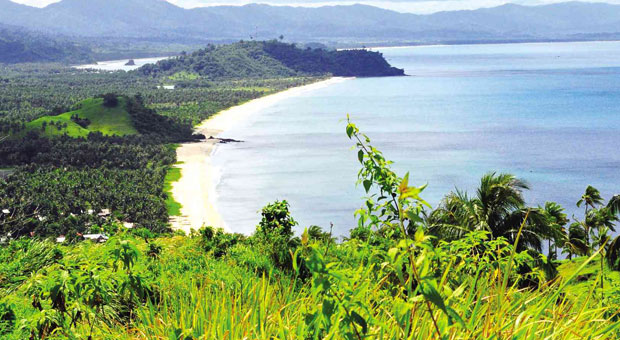
LONG BEACH This 14-kilometer stretch of shore covered with powdery white sand in San Vicente town, in the island province of Palawan, promises to become one of the Philippines’ top tourist destinations, as development continues involving the tourism industry’s big investors. PALAFOX ASSOCIATES/CONTRIBUTOR
The Inquirer is running a series of articles on the country’s tourism crown jewels—somehow uncut but equally sparkling and surprising as the usual vacation haunts. The stories will appear three times a week during the summer months. Please send us your own hot go-to discoveries to summer by. Text 09178177686 for details.–Ed.

SAN VICENTE, Palawan—Imagine trekking along 14 kilometers of unspoiled powdery white sand with nothing but the vast expanse of the West Philippine Sea and endless rows of lush forests and old coconut trees on both sides.
If you insist on been-there-done-that bragging rights, Palawan province’s Long Beach should top your list even before the first hotel hove into view and upbeat party music supplanted poignant evenings.
It’s easy to tell this place is going to transform in a big way.

A 2-km-runway airport nearby is due for completion this year and promises to dramatically boost tourist traffic. The cementing of the access road from the capital of Puerto Princesa City, or what used to be a decrepit logging road through old growth forest, is just about finished and will effortlessly link the place to the urban hub.
Most notably, the tourism industry’s big guys are already on board. They have figured this place out long before the first backpackers wandered into it. Among them was Anscor, which is into high-end island-resort development. They have locked in the prime locations along Long Beach, pouring in an estimated P1 billion in acquisitions in the last five years, according to local officials.

“There is no doubt that Long Beach is destined to become a world-class tourist destination. With its 14.7-km-long pristine stretch of beach, it is one of the longest, if not the longest, white-sand beach in the Philippines,” San Vicente Mayor Pie Alvarez told the Inquirer.

Alvarez is presiding over a meticulous planning process, which she hopes will ensure that tourism development can take place in Long Beach with optimum benefits to the local economy, “without sacrificing the environment.”
“We wish to learn from the best practices of tourism destinations around the world and create our own unique destination,” Alvarez said.

Natural beauty

Long Beach is a seemingly endless stretch of sand that arches along the western coastline of Palawan. From one’s seat as the plane descends, one can’t miss the glistening strip of sand at the edge of the lush forests of central Palawan. As one stands from one end of the beach, it is hard to see where it ends even on a clear day.
San Vicente’s planners can’t resist the comparison to Boracay Island in Panay that currently draws the bulk of beach hounds in the country. By its sheer size, Long Beach is Boracay magnified four times.

“One of our advantages is we have the opportunity to plan first before we build,” said municipal tourism officer Lucy Panagsagan.

The local government has a good reason to be cautious on how they should go about exploiting the area. Despite being the main hub of a logging operation in the late ’70s, San Vicente remains the most densely forested area of Palawan, with 86 percent of its total land area still covered by trees.

Its marine environment is host to an abundant fisheries resource. The town wants to make sure the fish remain, so they have designated at least six sites as fish sanctuaries or no-take zones.

A large chunk of the forest has been classified as a protected area under the National Integrated Area Protected Program. Nearly all wildlife species in the province can be found in San Vicente, including those considered to be at the brink of extinction such as the Philippine forest turtle (Heosemis leytensis), which can’t be found anywhere else in the world.

Land prices

Long-term investors from Manila and Cebu started the ball rolling for choice slices of real estate along Long Beach just over five years ago. Locals sold their land for as low as P70 per square meter, recalled Francis Picardal, a local entrepreneur.

Vice Mayor Antonio V. Gonzales recalled that at one time in 2007, he facilitated the acquisition of prime Long Beach properties for five prominent businessmen from Cebu province who shelled out P5 million each.

“In 2007, the landowners were happy to sell at P100 per square meter. These days, the price is between P4,000 to P5,000 per square meter,” Gonzales said.

Except for a handful of families, most of the original owners of the land, including the Agutaynen natives of San Vicente, have sold out to developers from out of town.

“It’s a sad reality that the original landowners were not able to hold on a bit longer to their properties,” Picardal said.

Getting there

Getting to San Vicente these days still requires an attitude most often alien to the soft-heeled. The interior roads from Puerto Princesa City are rough and travel can take as long as four hours.

San Vicente, at the moment, is still a backpacker’s delight. One can hop into an iconic rural bus usually packed to the roof, take a more comfortable shuttle service at P300 per passenger, or hire a van from Puerto Princesa City for somewhere between P6,000 and P7,000 per day.

The town proper is dusty to rustic and the only way to get around if one doesn’t have one’s own vehicle is to ride a habal-habal, a motorcycle with a slightly extended backseat for another passenger (or more, as is often the case).

Tourism master plan

The municipal tourism office lists just about 48 bed accommodations available in the town proper, mostly family-run lodging facilities made of light materials. One German entrepreneur with a Filipino wife built a hotel at the edge of town toward Long Beach that offers more familiar amenities, including a Wi-Fi connection and an infinity pool looking out into the ocean. Lodging rates range from P1,500 to P3,500 per day.

Last week, Palafox planners submitted to the municipality of San Vicente a draft tourism master plan. Among their major recommendations was to set a 50-meter exclusion zone from the high tide line of Long Beach, a distance twice the usually prescribed 25-meter no-build zone for coastal development.

The potential as a nature attraction is huge, according to the planners. Among the activities that could attract investors and visitors are windsurfing, surfboard riding, scuba diving and snorkeling, mangrove tours, rainforest treks, bird watching, island hopping, camping and sightseeing.

Gonzales said they would institutionalize their master plan by legislating their tourism master plan through an ordinance. It is the bible that property developers like Anscor, Big Foot Inc., Discovery Shores and other key tourism players have been waiting for so they can make their move.

For starters, Gonzales said, Tieza, the government’s tourism infrastructure arm, “is helping us in a major way”and has committed to help fund the completion of the town’s drainage plan and other turnkey infrastructure requirements targeting Long Beach.

“That’s what developers are waiting for. Once we have these things in place, development will naturally follow, Francis Picardal, a local lodge owner, said.

San Vicente had also enlisted in the Climate Change Commission’s “Ecotown” program to develop its own preparedness to confront nature-induced calamities brought about by changing weather conditions.
Ecotown consultant Dr. Antonio Carandang said the approach being taken by the municipality should help avoid the problems faced by other places that cater to large volumes of tourists.

“If carefully planned, Long Beach could be less commercial but more orderly and may surpass Boracay in terms of attracting high-end but environmentally aware tourists,”he said.

Mayor Alvarez insists they are not particularly intent on following Boracay’s development model, stating that it is more important for them to brand Long Beach as a unique destination that is world-class.

“Boracay is an already established world-class destination. We do not wish to compete but instead take the best practices and lessons learned from their tourism development methods. We hope we can create a destination that the Philippines can be proud of, always keeping in mind a holistic approach that balances community, development and the environment,”she said.

LONG BEACH FAST FACTS

Location: San Vicente, northern Palawan; southern part of Imuruan Bay, northern part of Pagdanan Bay
Distance from Puerto Princesa City: 186 kilometers

Accessibility: 3 to 4 hours land travel time from Puerto Princesa City; private van rentals from the city at P5,000 to 6,000 one-way

Characteristics: 14 km long

Attractions: Daplac Cove, Capari Cove Coral Reefs, Mangrove Forest, Wilson Head, Double Island, Naparay Coral Reefs, Little Baguio Waterfalls

Accommodations: Capari Resort, Peace and Love Resort, Ditchay Bed and Breakfast, John Eric Lodging, Picardal Lodge, Bahay ni Kuya, Station 5, M&D Resort, Nayarani Vilas

For your retirement and other housing needs, please visit http://www.gregmelep.com